

Ruha Benjamin: Race After Technology: Abolitionist Tools for the New Jim Code (2019)
Filed under book | Tags: · abolitionism, algorithm, artificial intelligence, dna, facebook, google, prediction market, race, racism, segregation, social media, surveillance, technology
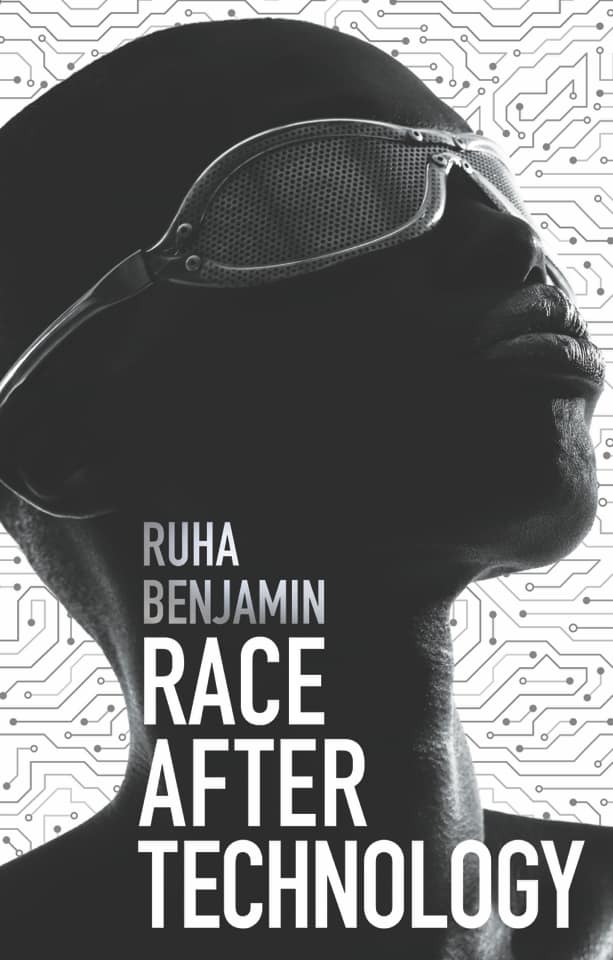
“From everyday apps to complex algorithms, Ruha Benjamin cuts through tech-industry hype to understand how emerging technologies can reinforce White supremacy and deepen social inequity.
Benjamin argues that automation, far from being a sinister story of racist programmers scheming on the dark web, has the potential to hide, speed up, and deepen discrimination while appearing neutral and even benevolent when compared to the racism of a previous era. Presenting the concept of the “New Jim Code,” she shows how a range of discriminatory designs encode inequity by explicitly amplifying racial hierarchies; by ignoring but thereby replicating social divisions; or by aiming to fix racial bias but ultimately doing quite the opposite. Moreover, she makes a compelling case for race itself as a kind of technology, designed to stratify and sanctify social injustice in the architecture of everyday life.
This illuminating guide provides conceptual tools for decoding tech promises with sociologically informed skepticism. In doing so, it challenges us to question not only the technologies we are sold but also the ones we ourselves manufacture.”
Publisher Polity Press, Cambridge, 2019
ISBN 9781509526406, 1509526404
x+285 pages
Interview with author (Sanjana Varghese, Guardian, 2019)
Comment (0)Nanna Bonde Thylstrup: The Politics of Mass Digitization (2018)
Filed under book | Tags: · book, cultural memory, digitisation, europeana, google, infrapolitics, infrastructure, knowledge, library, media infrastructure, monoskop, networks, shadow library, speed, ubuweb
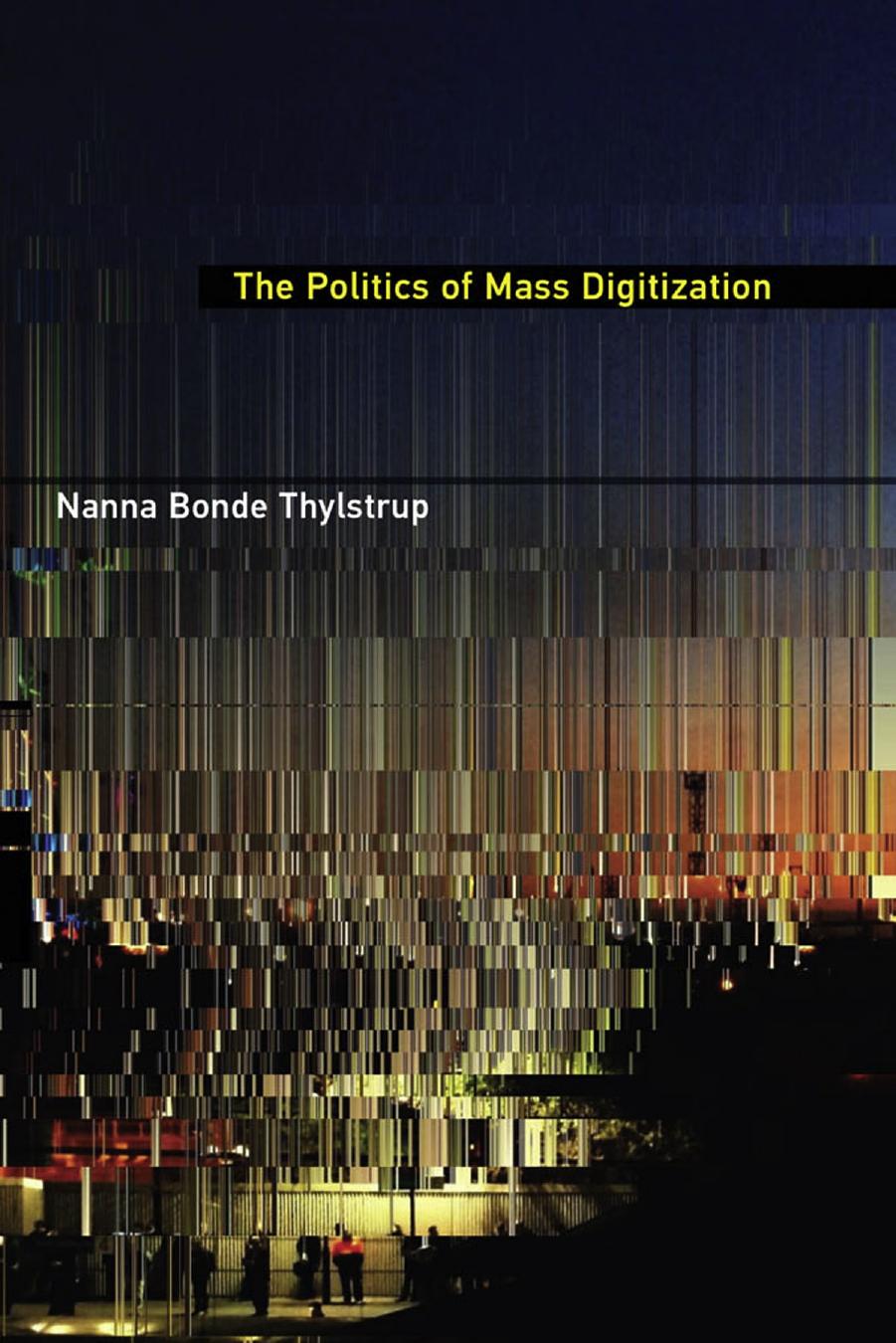
“A new examination of mass digitization as an emerging sociopolitical and sociotechnical phenomenon that alters the politics of cultural memory.
Today, all of us with internet connections can access millions of digitized cultural artifacts from the comfort of our desks. Institutions and individuals add thousands of new cultural works to the digital sphere every day, creating new central nexuses of knowledge. How does this affect us politically and culturally? In this book, Nanna Bonde Thylstrup approaches mass digitization as an emerging sociopolitical and sociotechnical phenomenon, offering a new understanding of a defining concept of our time.
Arguing that digitization has become a global cultural political project, Thylstrup draws on case studies of different forms of mass digitization—including Google Books, Europeana, and the shadow libraries Monoskop, lib.ru, and Ubuweb—to suggest a different approach to the study of digital cultural memory archives. She constructs a new theoretical framework for understanding mass digitization that focuses on notions of assemblage, infrastructure, and infrapolitics. Mass digitization does not consist merely of neutral technical processes, Thylstrup argues, but of distinct subpolitical processes that give rise to new kinds of archives and new ways of interacting with the artifacts they contain. With this book, she offers important and timely guidance on how mass digitization alters the politics of cultural memory to impact our relationship with the past and with one another.”
Publisher MIT Press, 2018
ISBN 9780262039017, 026203901X
ix+200 pages
Reviews: Paul Conway (Journal of the Association for Information Science and Technology, 2019), Logan Brown (New Media & Society, 2019), Marc Kosciejew (Information & Culture, 2019), Lizzie Martin (Convergence, 2019).
Commentary: Seb Chan (2019), Bill Caraher (2019).
Mondothèque: A Radiated Book / Un livre irradiant / Een irradiërend boek (2016) [EN, FR, NL]
Filed under book, wiki book | Tags: · architecture, archive, book, classification, data, document, google, internet, knowledge, library, web
“This Radiated Book started three years ago with an e-mail from the Mundaneum archive center in Mons, Belgium. It announced that Elio di Rupo, then prime minister of Belgium, was about to sign a collaboration agreement between the archive center and Google. The newsletter cited an article in the French newspaper Le Monde that coined the Mundaneum as ‘Google on paper’. It was our first encounter with many variations on the same theme.
The former mining area around Mons is also where Google has installed its largest datacenter in Europe, a result of negotiations by the same Di Rupo. Due to the re-branding of Paul Otlet as ‘founding father of the Internet’, Otlet’s oeuvre finally started to receive international attention. Local politicians wanting to transform the industrial heartland into a home for The Internet Age seized the moment and made the Mundaneum a central node in their campaigns. Google — grateful for discovering its posthumous francophone roots — sent chief evangelist Vint Cerf to the Mundaneum. Meanwhile, the archive center allowed the company to publish hundreds of documents on the website of Google Cultural Institute.
While the visual resemblance between a row of index drawers and a server park might not be a coincidence, it is something else to conflate the type of universalist knowledge project imagined by Paul Otlet and Henri Lafontaine with the enterprise of the search giant. The statement ‘Google on paper’ acted as a provocation, evoking other cases in other places where geographically situated histories are turned into advertising slogans, and cultural infrastructures pushed into the hands of global corporations.
An international band of artists, archivists and activists set out to unravel the many layers of this mesh. The direct comparison between the historical Mundaneum project and the mission of Alphabet Inc speaks of manipulative simplification on multiple levels, but to de-tangle its implications was easier said than done. Some of us were drawn in by misrepresentations of the oeuvre of Otlet himself, others felt the need to give an account of its Brussels’ roots, to re-insert the work of maintenance and caretaking into the his/story of founding fathers, or joined out of concern with the future of cultural institutions and libraries in digital times.” (from the Introduction)
Editorial team: André Castro, Sînziana Păltineanu, Dennis Pohl, Dick Reckard, Natacha Roussel, Femke Snelting, Alexia de Visscher
Publisher Constant, Brussels, Sep 2016
Free Art License 1.3
ISBN 9789081145954, 9081145959
225 pages
HTML (updated on 2019-5-31)
Git
PDF, PDF (43 MB)