

ReD (Revue Devětsilu): modern culture monthly (1927-1931) [Czech]
Filed under magazine | Tags: · architecture, art, art theory, avant-garde, bauhaus, constructivism, czechoslovakia, dada, design, film, graphic design, literature, photography, poetry, psychoanalysis, radio, surrealism, theatre
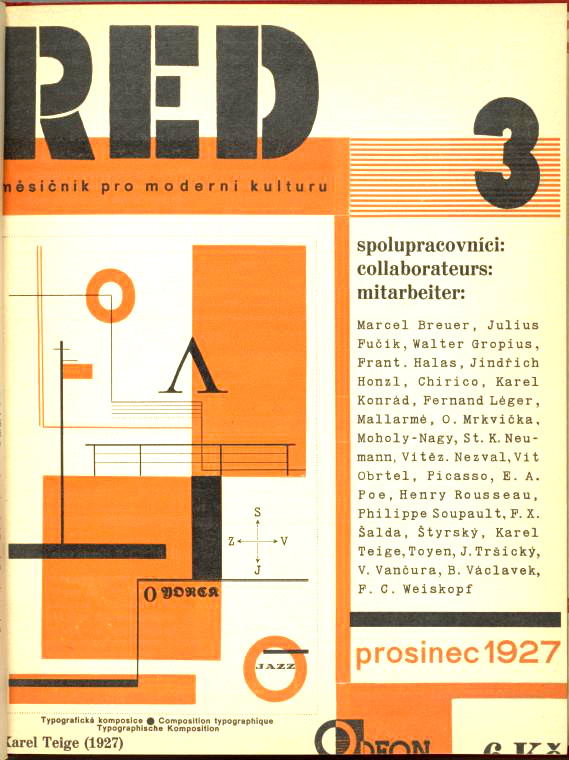
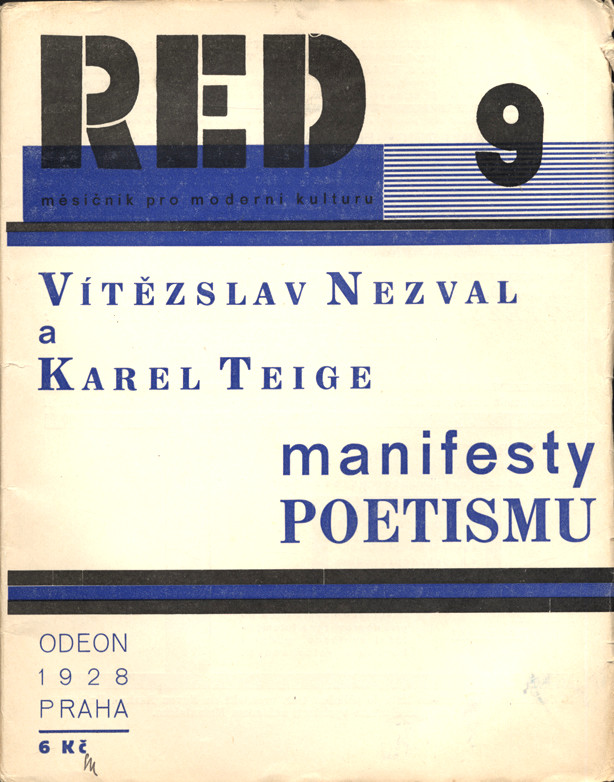
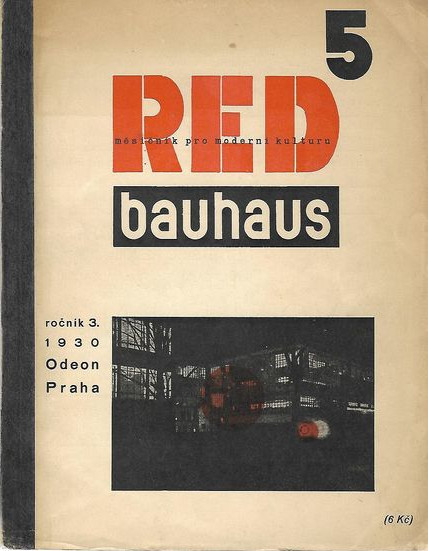
ReD (měsíčník pro moderní kulturu / Revue internationale illustrée de l’activité contemporaine / Internationale Monatsschrift für moderne Gestaltung) was an art magazine published by members of the Czech avant-garde art collective Devětsil.
Thirty numbers were published, with the special issues on the Russian avant-garde, Bauhaus, and photography/film/typography.
Several manifestos appeared in the journal: Toyen and Jindřich Štyrský’s Artificielisme (1:1, 1927), Karel Teige’s second Poetism manifesto [Manifest Poetismu] (1:9, 1928), and the Left Front [Levá fronta]’s founding manifesto (3:2, 1929).
Edited and designed by Karel Teige
Publisher Odeon – Jan Fromek, Prague
via NYPL Digital Library
Each volume in a single PDF (low resolution):
Volume I, 1927-1928 (10 issues, 360 pages)
Volume II, 1928-1929 (10 issues, 324 pages)
Volume III, 1929-1931 (10 issues, 315 pages)
Selected issues in separate PDFs:
The Russian Issue (1:2, Nov 1927)
Foto Film Typo Issue (2:8, Apr 1929)
The Bauhaus Issue (3:5, Feb 1930, partly in German)
JPG pages (search in page annotations):
View online
See also Devětsil: Revoluční sborník (1922), edited by Jaroslav Seifert and Karel Teige, in Czech.
Comment (1)R. Bruce Elder: Harmony and Dissent: Film and Avant-garde Art Movements in the Early Twentieth Century (2008)
Filed under book | Tags: · abstract cinema, art history, avant-garde, cinema, colour, constructivism, dissent, experimental film, film, film history, film theory, marxism, modernism, music, occultism, productivism, revolution, suprematism, symbolism, theology

“R. Bruce Elder argues that the authors of many of the manifestoes that announced in such lively ways the appearance of yet another artistic movement shared a common aspiration: they proposed to reformulate the visual, literary, and performing arts so that they might take on attributes of the cinema. The cinema, Elder argues, became, in the early decades of the twentieth century, a pivotal artistic force around which a remarkable variety and number of aesthetic forms took shape.
To demonstrate this, Elder begins with a wide-ranging discussion that opens up some broad topics concerning modernity’s cognitive (and perceptual) regime, with a view to establishing that a crisis within that regime engendered some peculiar, and highly questionable, epistemological beliefs and enthusiasms. Through this discussion, Elder advances the startling claim that a crisis of cognition precipitated by modernity engendered, by way of response, a peculiar sort of “pneumatic (spiritual) epistemology.” Elder then shows that early ideas of the cinema were strongly influenced by this pneumatic epistemology and uses this conception of the cinema to explain its pivotal role in shaping two key moments in early-twentieth-century art: the quest to bring forth a pure, “objectless” (non-representational) art and Russian Suprematism, Constructivism, and Productivism.”
Publisher Wilfrid Laurier University Press, Waterloo, 2008
ISBN 1554580285, 9781554580286
480 pages
Review: David Sterritt (Quarterly Review of Film and Video, 2011).
PDF (updated on 2019-12-14)
Comments (7)Boris Buden, Želimir Žilnik, kuda.org, et al.: Uvod u prošlost (2013) [Serbian]
Filed under book | Tags: · avant-garde, cinema, cultural history, culture, film, politics, yugoslavia
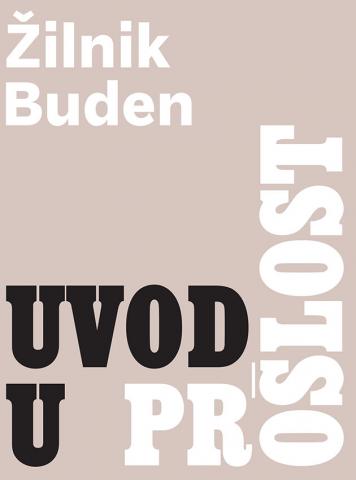
“Ovo je knjiga koja se naizgled bavi jednim sasvim određenim segmentom prošlosti, nečime što se je nekada zvalo kulturna povijest. No, tu kulturnu povijest ona ne tretira kao posebnu disciplinu historiografije koja za svoj predmet uzima ono što je u prošlosti steklo status kulturnog dobra. Za ovu knjigu kulturna povijest je sama forma u kojoj nam se danas ukazuje prošlost. U mjeri u kojoj smo svjesni prošlosti, svjesni smo je kao kulture.
Konkretno, kada se u ovoj knjizi govori o kulturnoj proizvodnji bivše Jugoslavije, o filmovima, odnosno o takozvanom filmskom jeziku redatelja Želimira Žilnika, kada se u njoj raspravlja o sukobima u kulturi, njihovim akterima, odnosu politike i umjetnosti, o ekonomskim pretpostavkama filmske produkcije i njenim društvenim efektima, onda se o tome ne govori u disciplinarnom smislu jedne, recimo, povijesti jugoslavenskog filma, odnosno, individualnog filmskog djela određenog redatelja, pri čemu kategorije društva, politike i ekonomije služe kontekstualizaciji jednog po sebi čisto kulturnog narativa. Kultura se ne zbiva u nekakvom unaprijed zadanom ekonomskom, političkom i društvenom kontekstu; ona je kao takva uvijek već i ekonomska činjenica i politički faktor i društveni proizvod. Ona nam ne govori o tome kakva je prošlost doista bila, nego jest ta prošlost u njenoj prisutnosti, aktualnosti, neizvjesnosti, otvorenosti. Ona je prošlost s onu stranu njene razlike spram sadašnjosti i budućnosti.” (Iz predgovora)
Publisher Centar za nove medije_kuda.org, Novi Sad, September 2013
kuda.read series
Copyleft license
ISBN 9788688567077
221 pages