

Anon Collective (ed.): Book of Anonymity (2021)
Filed under book | Tags: · anonymity, anonymous, art and science, data, digital culture, personhood, privacy, security, surveillance, technology

“Anonymity is highly contested, marking the limits of civil liberties and legality. Digital technologies of communication, identification, and surveillance put anonymity to the test. They challenge how anonymity can be achieved, and dismantled. Everyday digital practices and claims for transparency shape the ways in which anonymity is desired, done, and undone.
The Book of Anonymity includes contributions by artists, anthropologists, sociologists, media scholars, and art historians. It features ethnographic research, conceptual work, and artistic practices conducted in France, Germany, India, Iran, Switzerland, the UK, and the US. From police to hacking cultures, from Bitcoin to sperm donation, from Yik-Yak to Amazon and IKEA, from DNA to Big Data — thirty essays address how the reconfiguration of anonymity transforms our concepts of privacy, property, self, kin, addiction, currency, and labor.” (from back cover)
Contributors: Anon, Götz Bachmann, Dwaipayan Banerjee, Solon Barocas, Aram Bartholl, Amelie Baumann, Vadim Bernard, Paula Bialski, Andreas Broeckmann, Heath Bunting, Martin De Bie, Bureau d’études, Jacob Copeman, Abigail Curlew, Stéphane Degoutin, Simon Farid, Parastou Forouhar, Randi Heinrichs, Anna Henke, Michi Knecht, knowbotiq, Gertraud Koch, Julien McHardy, Helen Nissenbaum, Gerald Raunig, RYBN.ORG, Daniela Silvestrin, Thorsten Thiel, Transformella, Daniël de Zeeuw, Nils Zurawski.
Publisher Punctum Books, March 2021
Creative Commons BY-NC-SA 4.0 International license
ISBN 9781953035301
484 pages
HT coco
PDF (11 MB)
Comment (0)Hugh Davies: Sounds Heard: A Potpourri of Environmental Projects and Documentation, Projects with Children, Simple Musical Instruments, Sound Installations, Verbal Scores, and Historical Perspectives (2002)
Filed under sound recording | Tags: · composition, electronic music, environment, experimental music, improvised music, music, music criticism, musical instruments, sound, sound art
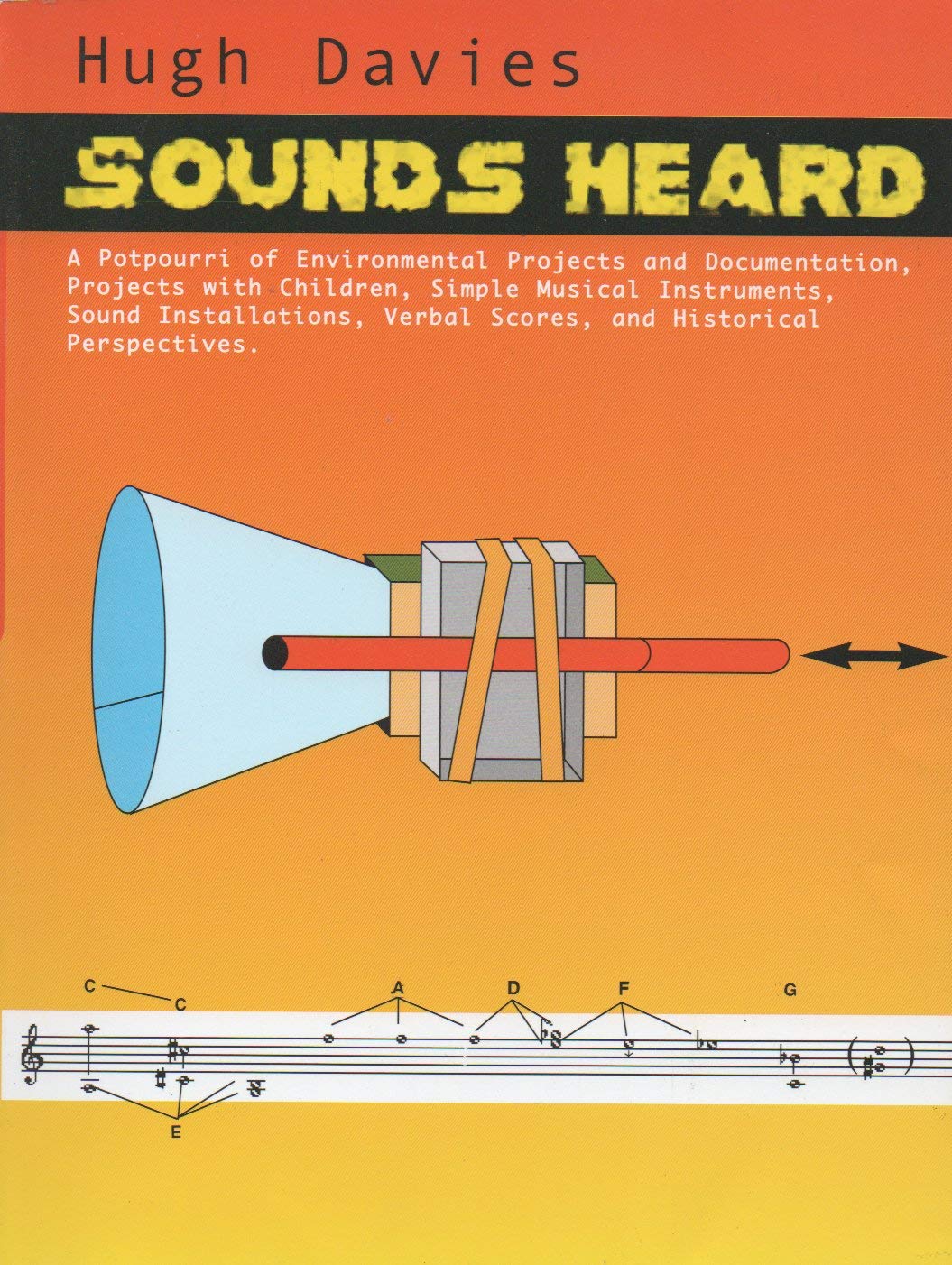
“Sounds Heard is not only a collection of writings intended for people who are interested or involved in contemporary music, especially those performers – including children – who lack a formal musical training. It also charts a wide cross-section of the activities of an intriguing musical personality. At different times in Hugh Davies’ nearly 40 year career he has been variously described as “the world’s leading electromusicologist”, “the most informed person around on the general subject of new instruments”, “unique English composer”, “one of the most interesting instrument inventors of recent decades”, “the remarkable live-electronics ‘freak”‘, an “electronic wizard”, “a humanist” and “I have never seen any music teacher who is as fond of children as he is”. Do these really refer to only one person? Who is the real Hugh Davies? Why has his modesty prevented him from being better known?
This book focuses on many of Davies’ insights about working as an artist, a musician, a composer, a performer, an instrument inventor, an educator and a researcher. He takes nothing for granted, and there are always wider implications than his own immediate involvement. Even his more avantgarde scenarios are tempered with his “very British sense of humour”. Many of the different areas of experimental music since the 1960s are touched on, including electronic music, live electronics, invented instruments, sound sculpture, sound installations and free improvisation, in all of which he was one of the British pioneers.
The CD illustrates a cross-section of the themes covered in the book. As with most of Hugh Davies’ solo performances and recordings, no conventional instruments were used on the entire album, with the exception of one short piece in which existing music has been manipulated with tape techniques.” (from back cover)
Publisher Soundworld Publishers, Chelmsford, 2002
ISBN 1902440056, 9781902440057
124 pages
PDF (29 MB)
Selections from accompanying CD
Curtis Roads (ed.): Composers and the Computer (1985)
Filed under book | Tags: · composing, composition, computer music, computing, electroacoustic music, electronic music, music, music criticism, music history, sound, technology
An early anthology focusing on the aesthetics and compositional techniques in computer music.
With essays by Curtis Roads, Charles Dodge, Tod Machover, Jean-Claude Risset, Iannis Xenakis, and an interview with Herbert Brün by Peter Hamlin with Curtis Roads.
Publisher William Kaufmann, Los Altos, CA, 1985
Computer Music and Digital Audio series
ISBN 0865760853, 9780865760851
xx+201 pages
Review: Jon Appleton (The Musical Quarterly, 1986).
PDF (57 MB)
See also Roads’s Composing Electronic Music: A New Aesthetic (2015).
Comment (0)