

Charlie Gere: Digital Culture. 2nd ed. (2009)
Filed under book | Tags: · arpanet, counterculture, cybernetics, cyberpunk, digital culture, facebook, fluxus, neoliberalism, technology

From our bank accounts to supermarket checkouts to the movies we watch, strings of ones and zeroes suffuse our world. Digital technology has defined modern society in numerous ways, and the vibrant digital culture that has now resulted is the subject of Charlie Gere’s engaging volume.
In this revised and expanded second edition, taking account of new developments such as Facebook and the iPhone, Charlie Gere charts in detail the history of digital culture, as marked by responses to digital technology in art, music, design, film, literature and other areas. After tracing the historical development of digital culture, Gere argues that it is actually neither radically new nor technologically driven: digital culture has its roots in the eighteenth century and the digital mediascape we swim in today was originally inspired by informational needs arising from industrial capitalism, contemporary warfare and counter-cultural experimentation, among other social changes.
A timely and cutting-edge investigation of our contemporary social infrastructures, Digital Culture is essential reading for all those concerned about the ever-changing future of our Digital Age.
Edition 2
Publisher Reaktion Books, 2009
ISBN 1861893884, 9781861893888
240 pages
PDF (updated on 2012-7-24)
Comment (0)John Johnston: The Allure of Machinic Life. Cybernetics, Artificial Life, and the New AI (2008)
Filed under book | Tags: · abstract machine, artificial intelligence, artificial life, cellular automata, connectionism, cybernetics, genetic algorithms, robotics, swarm intelligence

“In The Allure of Machinic Life, John Johnston examines new forms of nascent life that emerge through technical interactions within human-constructed environments—”machinic life”—in the sciences of cybernetics, artificial life, and artificial intelligence. With the development of such research initiatives as the evolution of digital organisms, computer immune systems, artificial protocells, evolutionary robotics, and swarm systems, Johnston argues, machinic life has achieved a complexity and autonomy worthy of study in its own right.
Drawing on the publications of scientists as well as a range of work in contemporary philosophy and cultural theory, but always with the primary focus on the “objects at hand”—the machines, programs, and processes that constitute machinic life—Johnston shows how they come about, how they operate, and how they are already changing. This understanding is a necessary first step, he further argues, that must precede speculation about the meaning and cultural implications of these new forms of life.
Developing the concept of the “computational assemblage” (a machine and its associated discourse) as a framework to identify both resemblances and differences in form and function, Johnston offers a conceptual history of each of the three sciences. He considers the new theory of machines proposed by cybernetics from several perspectives, including Lacanian psychoanalysis and “machinic philosophy.” He examines the history of the new science of artificial life and its relation to theories of evolution, emergence, and complex adaptive systems (as illustrated by a series of experiments carried out on various software platforms). He describes the history of artificial intelligence as a series of unfolding conceptual conflicts—decodings and recodings—leading to a “new AI” that is strongly influenced by artificial life. Finally, in examining the role played by neuroscience in several contemporary research initiatives, he shows how further success in the building of intelligent machines will most likely result from progress in our understanding of how the human brain actually works.”
Publisher MIT Press, 2008
ISBN 0262101262, 9780262101264
461 pages
PDF (updated on 2012-10-31)
Comment (0)Peter Weibel (ed.): Beyond Art: A Third Culture. A Comparative Study in Cultures, Art and Science in 20th Century Austria and Hungary (2005)
Filed under book | Tags: · art, art and science, art history, austria, computer art, conceptual art, cybernetics, history of science, hungary, mathematics, media art, philosophy, psychoanalysis, technology
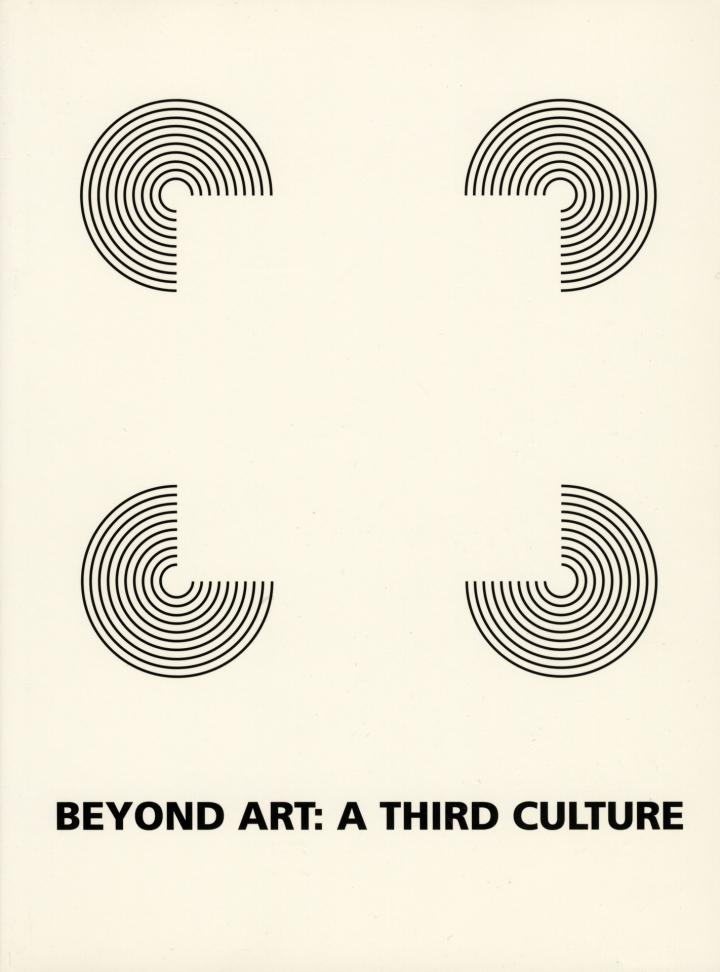
“Austria and Hungary in the 20th century were nations that made enormous achievements in the formal sciences and arts: abstraction, logic, mathematics, physics, positivism, psychoanalysis, cybernetics, constructivism, economics, art, media art, and concept art. Art and science are usually divided into two different cultures, and nations, too, are seen as having separate ones. This book delivers a new model of consilience and convergence of art and science by closely studying in a material historical way by using a multitude of original papers and contributions, photographs, documents, bibliographies, biographies, and survey essays, the mutual influence of art and science in Austria and Hungary. In fields ranging from Gestalt psychology to Quantum physics, from constructivism to theories of vision, from holography to cyberspace, we discover a multitude of ideas, books, movements and personalities that have deeply influenced the world. Richly illustrated, the book is a nearly invaluable sourcebook, in which a new method, resembling more a CD-ROM narration than a dictionary, has been used to map an unknown horizon of knowledge. Those involved in the history of science or art and in the field of cultural theory, will find an incomparable frame of reference and information. They will discover not only genius, talents and themes they have not been aware of, but also a new model of culture, a third culture. The book is graphically and structurally user-friendly with a synopsis for each chapter, models, diagrams, images, corolaries and index etc.”
Publisher Springer, Vienna, 2005
ISBN 3211245626, 9783211245620
616 pages
PDF (40 MB, updated on 2019-10-30)
Comments (2)