

Harald Szeemann, et al.: Documenta 5, catalogue (1972) [DE]
Filed under catalogue | Tags: · advertising, art, conceptual art, film, institutional critique, light art, museum, outsider art, performance art, politics, propaganda, realism, science fiction, systems art, utopia
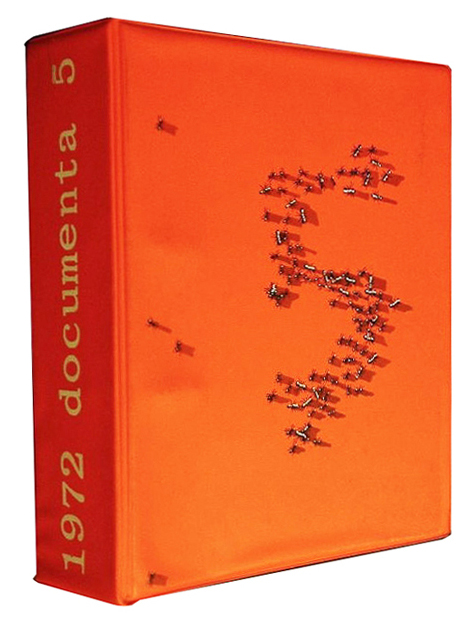
“Even decades later, Documenta 5, the exhibition that was criticized in 1972 as being “bizarre.. vulgar.. sadistic” by Hilton Kramer (NYT) and “monstrous.. overtly deranged” by Barbara Rose (NYM), resonates today as one of the most important exhibitions in history. Both hailed and derided by artists and critics, the exhibition was the largest, most expensive and most diverse of any exhibition anywhere, and foreshadowed all large-scale, collaboratively curated, comprehensive mega-shows to come.
Chiefly curated by the Swiss curator, Harald Szeemann, it was a pioneering, radically different presentation that was conceived as a 100-day event, with performances and happenings, outsider art, even non-art, as well as repeated Joseph Beuys lectures, and an installation of Claes Oldenburg’s Mouse Museum, among many other atypical inclusions. The show widely promoted awareness of a contract known as The Artist’s Reserved Rights Transfer and Sale Agreement, which protects artists’ ongoing intellectual and financial rights with regard to their production.” (Source)
“Featuring the works of over 170 artists and an equally expansive variety of materials and subjects drawn from popular cultural materials such as science fiction publications, kitsch objects, exploitation films, as well as advertising imagery, in addition to the more anticipated painting and sculpture – Documenta 5 valiantly attempted to bridge the gap between art, culture, science and the broader society.
A lasting highlight of the exhibition was the graphic logo for the show designed by Edward Ruscha. Commissioned by Szeeman, Ruscha’s graphic image for the show featured ants arranged in the word ‘Docu / menta’ and the number ‘5.’ The emblem was used on the exhibition’s poster and catalogue cover.” (Source)
Contents of Part B:
1 Hans Heinz Holz: Kritische Theorie des ästhetischen Zeichens (catalogue foreword, 86 pp),
2 Bazon Brock & Karl Heinz Krings: Audiovisuelles Vorwort (audiovisual foreword, 19 pp),
3 Eberhard Roters: Trivialrealismus & Trivialemblematik (16 pp),
4 Ingolf Bauer: Bilderwelt und Froemmigkeit (10 pp),
5 Gesellschaftliche Ikonographie an zwei Beispielen (8 pp),
6 Charles Wilp, Hans Heinz Holz: Werbung (4 pp),
7 Reiner Diederich, Richard Grübling, Klaus Staeck: Politische Propaganda (14 pp),
8 Pierre Versins: Science Fiction/Heute von gestern gesehen (10 pp),
9 François Burkhardt: Utopie/Morgen von gestern gesehen (16 pp),
10 Ursula Barthelmess, Hans-Henning Borgelt, Linde Burkhardt, Wolfgang Hoebig: Spiel und Wirklichkeit (14 pp),
11 Theodor Spoerri: Bildnerei der Giesteskranken (18 pp),
12 Gerhard Buettenbender, Sigurd Hermes: Film (28 pp),
13 Museen von Künstlern (17 pp),
14 Sozialistischer Realismus (1 p),
15 Jean-Christophe Ammann: Realismus (58 pp),
16 Johannes Cladders, Harald Szeemann: Individuelle Mythologien – Selbstdarstellung: a) Performance, b) Film – Prozesse (220 pp),
17 Konrad Fischer, Klaus Honnef, Gisela Kaminski: Idee + Idee / Licht (92 pp),
18 Information + The Artist’s Reserved Rights Transfer and Sale Agreement (44 pp),
19 Verzeichnis der ausgestellten Werke
20 Allgemeine Bibliographie
21 Waehrend: Ereigniskalender
22 Nachher 1: Text
23 Nachher 2: Bild
24 Nachher 3: Presse
25 Fotonachweis
documenta 5. Befragung der Realität – Bildwelten heute
Edited by Harald Szeemann, Marlis Grüterich, Katia von den Velden, Jennifer Gough-Cooper
Publisher documenta and Bertelsmann, Kassel, 1972
ISBN 3570028569, 9783570028568
64+80 & 740+ pages
via The DOR (at Archive.org)
Analyses and commentaries:
3sat TV documentary (video, 41 min, 1972, DE)
Der Spiegel (1972, DE)
Klaus Herding & Hans-Ernst Mittig on Holz’s foreword (Kritische Berichte, 1973, DE)
Documenta 5 in Art Since 1900 (2004, EN)
Dirk Schwarze (Documenta Archiv, 2014, DE)
Maria Bremer (Stedelijk Studies, 2015, EN)
documenta Archiv, (2)
Wikipedia (DE)
WorldCat
Part A (144 pp, PDF, 57 MB)
Part B (740+ pp, PDF, 287 MB, sections 19-24 missing; updated on 2023-3-28)
Bad Object-Choices (eds.): How Do I Look? Queer Film And Video (1991)
Filed under book | Tags: · cinema, feminism, film, film theory, gender, lgbtq, pornography, queer theory, race, representation, sex, sexuality, video
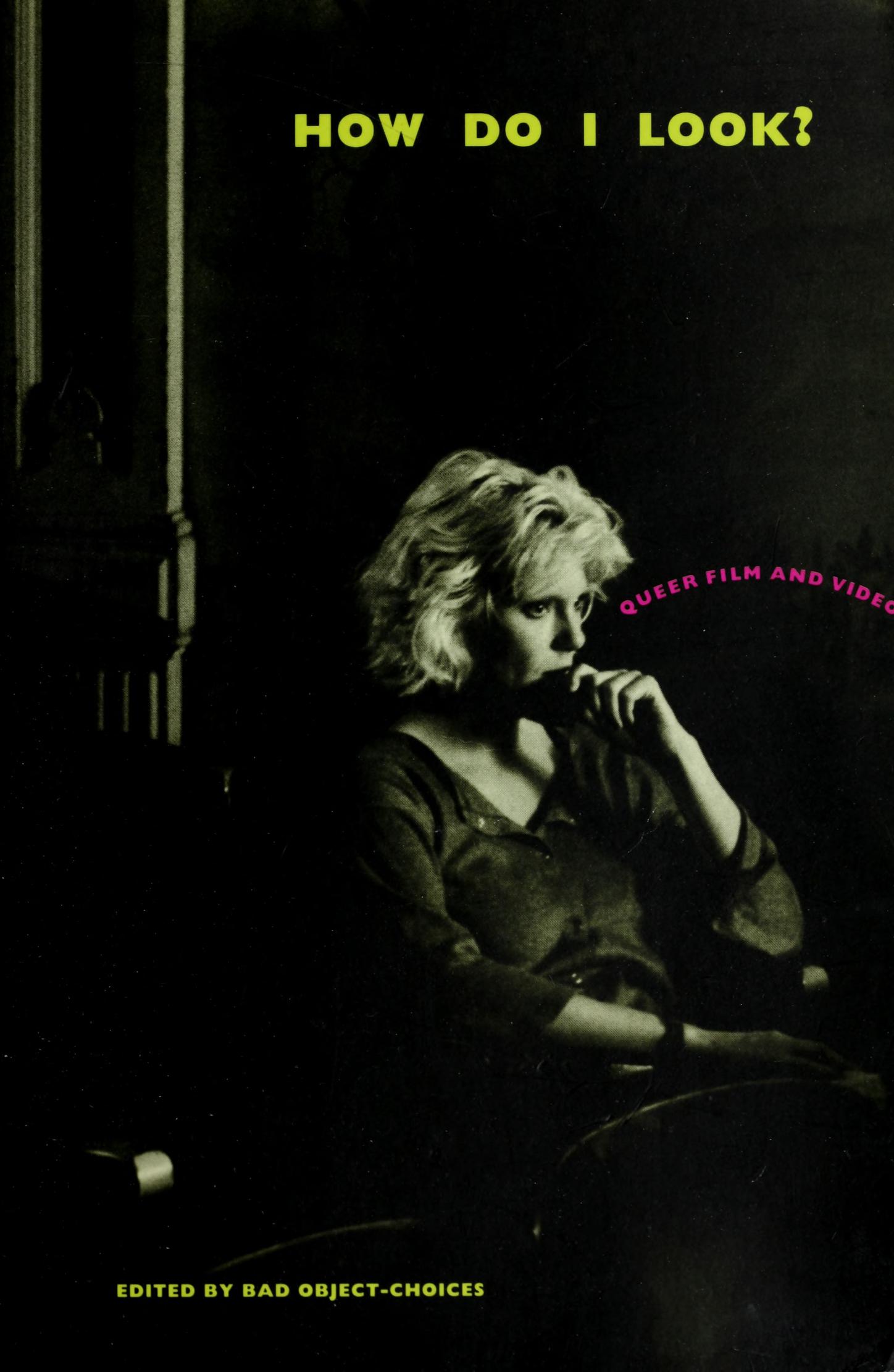
“The papers and discussions published here comprise the proceedings of a conference held at Anthology Film Archives in New York City, October 1989, organized by Bad Object-Choices, a reading group formed in the spring of 1987 to address questions of gay and lesbian theory. The proceedings were edited by the following group members: Terri Cafaro, Jean Carlomusto, Douglas Crimp, Martha Gever, Tom Kalin, and Jeff Nunokawa.” (from the Preface)
The publication was prepared as a special issue of October journal, but ultimately rejected by the editors; and further delayed as more than twenty printers refused to print the book–at issue were images in the Patton, Mercer, and Fung essays. It was eventually printed in Germany. (see interview with Douglas Crimp and p. 10)
With essays by Cindy Patton, Stuart Marshall, Judith Mayne, Richard Fung, Kobena Mercer, and Teresa de Laurentis.
Publisher Bay Press, Seattle, WA, 1991
ISBN 0941920208
295 pages
Reviews: Jennifer A. Machiorlatti (Journal of Film and Video, 1993), Thomas Dukes (Journal of the History of Sexuality, 1994), Lauri Mullens (Int’l Gay & Lesbian Review).
PDF (65 MB, no OCR)
Comment (0)Sean Cubitt, Daniel Palmer, Nathaniel Tkacz (eds.): Digital Light (2015)
Filed under book | Tags: · aesthetics, art, cinema, digital, film, image, light, optics, photography, screen, technology, vision
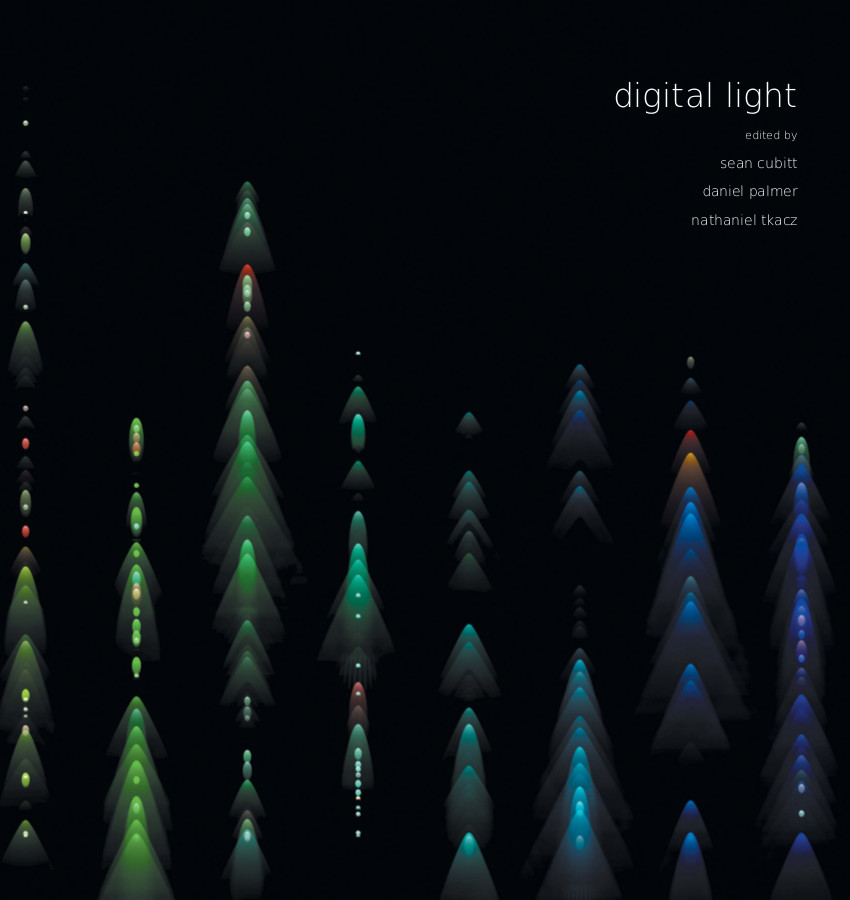
“Light symbolises the highest good, it enables all visual art, and today it lies at the heart of billion-dollar industries. The control of light forms the foundation of contemporary vision. Digital Light brings together artists, curators, technologists and media archaeologists to study the historical evolution of digital light-based technologies. Digital Light provides a critical account of the capacities and limitations of contemporary digital light-based technologies and techniques by tracing their genealogies and comparing them with their predecessor media. As digital light remediates multiple historical forms (photography, print, film, video, projection, paint), the collection draws from all of these histories, connecting them to the digital present and placing them in dialogue with one another.
Light is at once universal and deeply historical. The invention of mechanical media (including photography and cinematography) allied with changing print technologies (half-tone, lithography) helped structure the emerging electronic media of television and video, which in turn shaped the bitmap processing and raster display of digital visual media. Digital light is, as Stephen Jones points out in his contribution, an oxymoron: light is photons, particulate and discrete, and therefore always digital. But photons are also waveforms, subject to manipulation in myriad ways. From Fourier transforms to chip design, colour management to the translation of vector graphics into arithmetic displays, light is constantly disciplined to human purposes. In the form of fibre optics, light is now the infrastructure of all our media; in urban plazas and handheld devices, screens have become ubiquitous, and also standardised. This collection addresses how this occurred, what it means, and how artists, curators and engineers confront and challenge the constraints of increasingly normalised digital visual media.
While various art pieces and other content are considered throughout the collection, the focus is specifically on what such pieces suggest about the intersection of technique and technology. Including accounts by prominent artists and professionals, the collection emphasises the centrality of use and experimentation in the shaping of technological platforms. Indeed, a recurring theme is how techniques of previous media become technologies, inscribed in both digital software and hardware. Contributions include considerations of image-oriented software and file formats; screen technologies; projection and urban screen surfaces; histories of computer graphics, 2D and 3D image editing software, photography and cinematic art; and transformations of light-based art resulting from the distributed architectures of the internet and the logic of the database.”
Publisher Open Humanities Press, London, 2015
Fibreculture Books series
Creative Commons BY-SA 4.0 License
ISBN 1785420089, 9781785420085
224 pages
Review: Mathias Denecke (Culture Machine, 2016).
PDF, PDF, PDF (4 MB, updated on 2016-7-19)
Comment (0)