

Niklas Luhmann: The Reality of the Mass Media (1995/2000)
Filed under book | Tags: · autopoiesis, communication, cybernetics, information, mass media, media theory, recursion, social science, systems theory, theory of communication

“In The Reality of the Mass Media, Luhmann extends his theory of social systems — applied in his earlier works to the economy, the political system, art, religion, the sciences, and law — to an examination of the role of mass media in the construction of social reality.
Luhmann argues that the system of mass media is a set of recursive, self-referential programs of communication, whose functions are not determined by the external values of truthfulness, objectivity, or knowledge, nor by specific social interests or political directives. Rather, he contends that the system of mass media is regulated by the internal code information/noninformation, which enables the system to select its information (news) from its own environment and to communicate this information in accordance with its own reflexive criteria.
Despite its self-referential quality, Luhmann describes the mass media as one of the key cognitive systems of modern society, by means of which society constructs the illusion of its own reality. The reality of mass media, he argues, allows societies to process information without destabilizing social roles or overburdening social actors. It forms a broad reservoir (memory) of options for the future coordination of action, and it provides parameters for the stabilization of political reproduction of society, as it produces a continuous self-description of the world around which modern society can orient itself.
In his discussion of mass media, Luhmann elaborates a theory of communication in which communication is seen not as the act of a particular consciousness, nor the medium of integrative social norms, but merely the technical codes through which systemic operations arrange and perpetuate themselves.”
First published as Die Realität der Massenmedien, Westdeutscher Verlag, 1995.
Translated by Kathleen Cross
Published by Stanford University Press, 2000
ISBN 0804740771, 9780804740777
154 pages
Key terms: mass media, second-order cybernetics, autopoiesis, Heinz von Foerster, autopoietic, Laws of Form, Elisabeth Noelle-Neumann, constructivist epistemology, Gregory Bateson, recursive, Spencer Brown, Katherine Hayles, Michel Serres, Baltasar Gracian, Amos Tversky, Hans Ulrich Gumbrecht, munication, Ludwig Tieck
PDF (updated on 2012-7-17)
Comment (0)Gene Youngblood: Expanded Cinema (1970)
Filed under book | Tags: · art, art history, computer film, computing, cybernetics, expanded cinema, experimental film, film theory, holography, intermedia, media art, multimedia, technology, television, video, video art
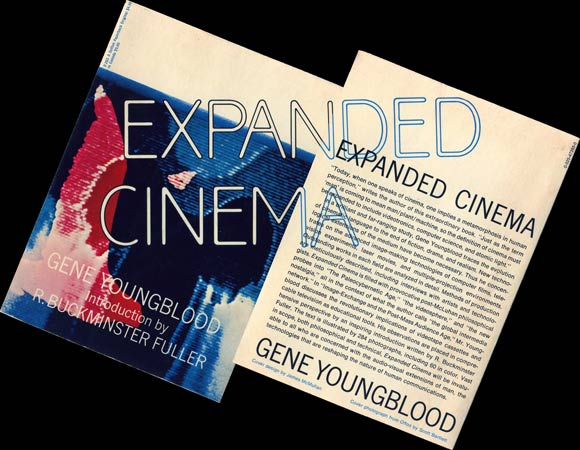
“The first book to consider video as an art form, was influential in establishing the field of media arts. In the book he argues that a new, expanded cinema is required for a new consciousness. He describes various types of filmmaking utilising new technology, including film special effects, computer art, video art, multi-media environments and holography.” (Wikipedia)
Part One: The Audience and the Myth of Entertainment
Part Two: Synaesthetic Cinema: The End of Drama
Part Three: Toward Cosmic Consciousness
Part Four: Cybernetic Cinema and Computer Films
Part Five: Television as a Creative Medium
Part Six: Intermedia
Part Seven: Holographic Cinema: A New World
Key words and phrases: Jordan Belson, expanded cinema, Nam June Paik, Buckminster Fuller, Stan VanDerBeek, videotronic, Ronald Nameth, Carolee Schneemann, John McHale, Expo 67, slit-scan, John Cage, light pen, Gene Youngblood, Otto Piene, Beflix, Howard Wise, KQED, Samadhi, WGBH-TV
Introduction by R. Buckminster Fuller
Publisher E.P. Dutton, New York, 1970
SBN 0525101527
432 pages
Reviews: Paul Cowen (Leonardo, 1972), Thomas Beard (Artforum, 2020), Caroline A. Jones (Artforum, 2020).
Analysis: Adam Sindre Johnson (2010, NO).
PDF (45 MB, no OCR, via Internet Archive, added on 2016-3-2)
PDF, PDF, PDF (5 MB, OCR)
PDF chapters
Grant D. Taylor: The Machine That Made Science Art: The Troubled History of Computer Art 1963-1989 (2004)
Filed under thesis | Tags: · aesthetics, art, art history, computer art, computing, cybernetics, programming, technology
“This thesis represents an historical account of the reception and criticism of computer art from its emergence in 1963 to its crisis in 1989, when aesthetic and ideological differences polarise and eventually fragment the art form. Throughout its history, static-pictorial computer art has been extensively maligned. In fact, no other twentieth-century art form has elicited such a negative and often hostile response. In locating the destabilising forces that affect and shape computer art, this thesis identifies a complex interplay of ideological and discursive forces that influence the way computer art has been and is received by the mainstream artworld and the cultural community at large. One of the central factors that contributed to computer art’s marginality was its emergence in that precarious zone between science and art, at a time when the perceived division between the humanistic and scientific cultures was reaching its apogee. The polarising force inherent in the “two cultures” debate framed much of the prejudice towards early computer art. For many of its critics, computer art was the product of the same discursive assumptions, methodologies and vocabulary as science. Moreover, it invested heavily in the metaphors and mythologies of science, especially logic and mathematics. This close relationship with science continued as computer art looked to scientific disciplines and emergent techno-science paradigms for inspiration and insight. While recourse to science was a major impediment to computer art’s acceptance by the artworld orthodoxy, it was the sustained hostility towards the computer that persistently wore away at the computer art enterprise. The anticomputer response came from several sources, both humanist and anti-humanist. The first originated with mainstream critics whose strong humanist tendencies led them to reproach computerised art for its mechanical sterility. A comparison with aesthetically and theoretically similar art forms of the era reveals that the criticism of computer art is motivated by the romantic fear that a computerised surrogate had replaced the artist. Such usurpation undermined some of the keystones of modern Western art, such as notions of artistic “genius” and “creativity”. Any attempt to rationalise the human creative faculty, as many of the scientists and technologists were claiming to do, would for the humanist critics have transgressed what they considered the primordial mystique of art. Criticism of computer art also came from other quarters. Dystopianism gained popularity in the 1970s within the reactive counter-culture and avant-garde movements. Influenced by the pessimistic and cynical sentiment of anti-humanist writings, many within the arts viewed the computer as an emblem of rationalisation, a powerful instrument in the overall subordination of the individual to the emerging technocracy.” (Abstract)
Ph.D. Thesis
Landscape and Visual Arts, The Faculty of Architecture, The University of Western Australia, 2004
via MediaArtHistories
PDFs (updated on 2016-2-17)
Comment (0)