

Radical Software (1970-1974)
Filed under magazine | Tags: · art, computer art, electromagnetism, software, technology, television, video, video art
The historic video magazine Radical Software was started by Beryl Korot, Phyllis Gershuny, and Ira Schneider and first appeared in Spring of 1970, soon after low-cost portable video equipment became available to artists and other potential videomakers. Though scholarly works on video art history often refer to Radical Software, there are few places where scholars can review its contents. Individual copies are rare, and few complete collections exist.
Radical Software was an important voice of the American video community in the early 70s; the only periodical devoted exclusively to independent video and video art at the time when those subjects were still being invented. Issues included contributions by Nam June Paik, Douglas Davis, Paul Ryan, Frank Gillette, Beryl Korot, Charles Bensinger, Ira Schneider, Ann Tyng, R. Buckminster Fuller, Gregory Bateson, Gene Youngblood, Parry Teasdale, Ant Farm, and many others.
Eleven issues of Radical Software were published from 1970 to 1974, first by the Raindance Corporation and then by the Raindance Foundation with Gordon and Breach Publishers.

Radical Software, Volume I, Number 1
The Alternate Television Movement,
Spring 1970
PDF

Radical Software, Volume I, Number 2
The Electromagnetic Spectrum,
Autumn 1970
PDF

Radical Software, Volume I, Number 3
Untitled, Spring 1971
PDF

Radical Software, Volume I, Number 4
Untitled, Summer 1971
PDF

Radical Software, Volume I, Number 5
Realistic Hope Foundation,
Spring 1972
PDF

Radical Software, Volume II, Number 1
Changing Channels, Winter 1972
PDF

Radical Software, Volume II, Number 2
The TV Environment, Spring 1973
PDF

Radical Software, Volume II, Number 3
Videocity, Summer 1973
PDF

Radical Software, Volume II, Number 4
Solid State, Autumn 1973
PDF

Radical Software, Volume II, Number 5
Video and Environment, Winter 1973
PDF

Radical Software, Volume II, Number 6
Video and Kids, Summer 1974
PDF
Charlie Gere: Art, Time, and Technology (2006)
Filed under book | Tags: · art, avant-garde, conceptual art, electronic art, mail art, net art, technology, time

Art, Time and Technology examines the role of art in an age of ‘real time’ information systems and instantaneous communication. The increasing speed of technology and of technological development since the early nineteenth century has resulted in cultural anxiety. Humankind now appears to be an ever-smaller component of dauntingly complex technological systems, operating at speeds beyond human control or even perception. This perceived change forces us to rethink our understanding of key concepts such as time, history and art. Art, Time and Technology explores how the practice of art – in particular of avant-garde art – keeps our relation to time, history and even our own humanity open. Examining key moments in the history of both technology and art from the beginnings of industrialization to today, Charlie Gere explores both the making and purpose of art, and how much further it can travel from the human body.
Published by Berg, 2006
ISBN 1845201353, 9781845201357
195 pages
Key terms: net.art, Staiti, avant-garde, conceptual art, Bernard Stiegler, real-time computing, Lyotard, John McHale, Suprematism, Jacques Derrida, Suprematist, Hans Haacke, mail art, DEW Line, Vincent Van Gogh, Roy Ascott, Buckminster Fuller, Douglas Huebler, Metal Machine Music
PDF (updated on 2012-7-24)
Comment (0)Gene Youngblood: Expanded Cinema (1970)
Filed under book | Tags: · art, art history, computer film, computing, cybernetics, expanded cinema, experimental film, film theory, holography, intermedia, media art, multimedia, technology, television, video, video art
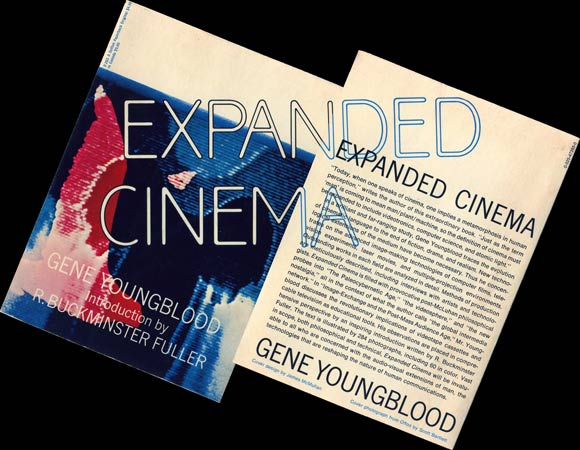
“The first book to consider video as an art form, was influential in establishing the field of media arts. In the book he argues that a new, expanded cinema is required for a new consciousness. He describes various types of filmmaking utilising new technology, including film special effects, computer art, video art, multi-media environments and holography.” (Wikipedia)
Part One: The Audience and the Myth of Entertainment
Part Two: Synaesthetic Cinema: The End of Drama
Part Three: Toward Cosmic Consciousness
Part Four: Cybernetic Cinema and Computer Films
Part Five: Television as a Creative Medium
Part Six: Intermedia
Part Seven: Holographic Cinema: A New World
Key words and phrases: Jordan Belson, expanded cinema, Nam June Paik, Buckminster Fuller, Stan VanDerBeek, videotronic, Ronald Nameth, Carolee Schneemann, John McHale, Expo 67, slit-scan, John Cage, light pen, Gene Youngblood, Otto Piene, Beflix, Howard Wise, KQED, Samadhi, WGBH-TV
Introduction by R. Buckminster Fuller
Publisher E.P. Dutton, New York, 1970
SBN 0525101527
432 pages
Reviews: Paul Cowen (Leonardo, 1972), Thomas Beard (Artforum, 2020), Caroline A. Jones (Artforum, 2020).
Analysis: Adam Sindre Johnson (2010, NO).
PDF (45 MB, no OCR, via Internet Archive, added on 2016-3-2)
PDF, PDF, PDF (5 MB, OCR)
PDF chapters