

Chuck Welch (ed.): Eternal Network: A Mail Art Anthology (1995)
Filed under book | Tags: · art, art history, artists book, computer art, dada, fluxus, internet, mail art, network art, networks, visual poetry, zine culture
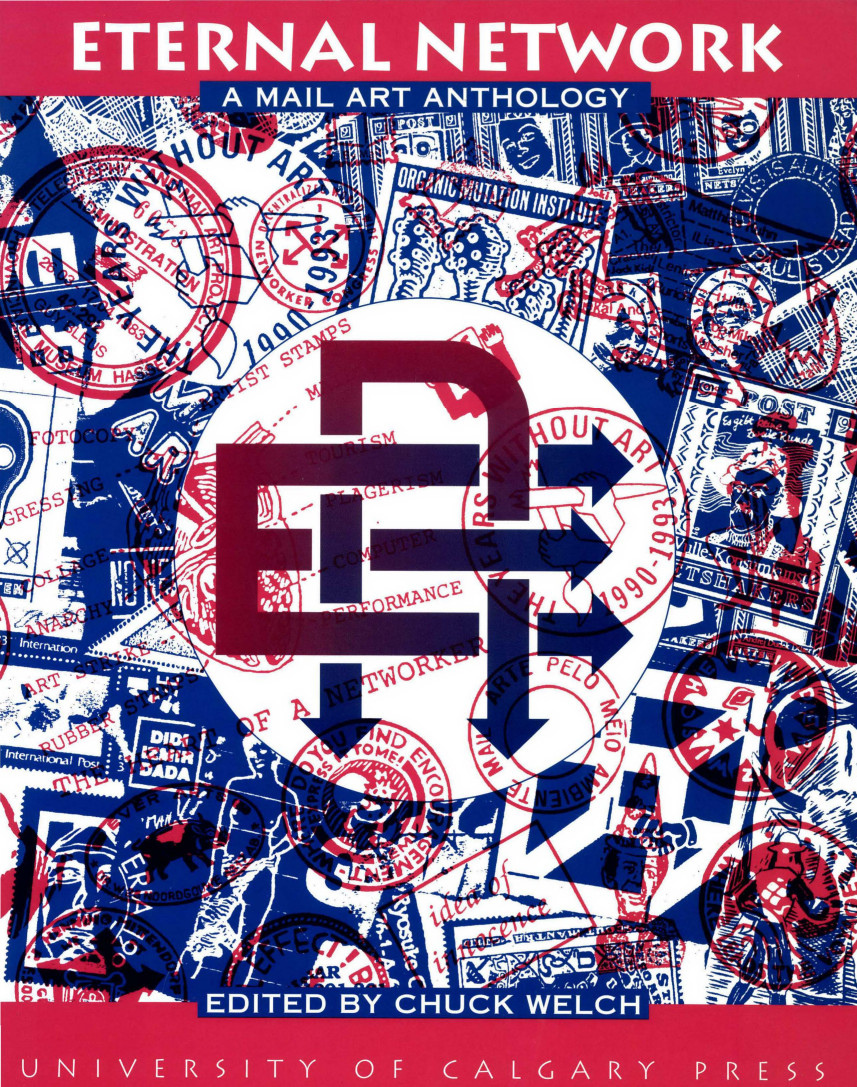
“This book is the first university press publication in academia to explore the historical roots, aesthetics and new directions in mail art. The essays of Eternal Network were written and assembled during the early 1990s by mail artist, writer, and curator, Chuck Welch. The edition contains forty illustrated chapters surveying an international community whose mailboxes and computers were a proto internet bridging the analog and digital world of art and communication. Eternal Network includes numerous photographs of mailed artifacts, performance events, congresses, stampsheets, posters, collages, artists’ books, visual poetry, computer art, mail art projects, zines, copy art and rubber-stamped images.
The book is divided into six parts: Networking Origins, Open Aesthetics, New Directions, Interconnection of Worlds, Communication Issues and Ethereal Realms. Appendixes include mailing addresses from the 1990s, mail art exhibitions, a listing and location of over 350 underground mail art magazines and a comprehensive record of public and private international mail art archives. The late Judith Hoffberg, founder of Art Libraries Society of North America (ARLIS) and editor of Umbrella Magazine, wrote an astute and prophetic review of Eternal Network in March 1995. “Some might think that this is the last gasp of a paper-orientated group of artists, but it is more a testament to the future of alternative art and the role of artists as networker”.”
With a Foreword by Ken Friedman
Publisher University of Calgary Press, Calgary, 1995
ISBN 1895176271, 9781895176278
xxiii+304 pages
via Chuck Welch, (2)
PDF (147 MB)
Comments (2)Report from the Gutenberg Galaxy (Blaker), 1-2 (2015) [English/Norwegian]
Filed under booklet | Tags: · archive, art, artists book, book
A series of two publications released in connection with the exhibition project The Gutenberg Galaxy at Blaker
(2013–2015) which takes as its point of departure the archive of the artist Guttorm Guttormsgaard, a collection of tens of thousands of objects he has collected with the intention of “documenting necessary impulses to keep one’s spirits up.” The archive is located in a former dairy in Blaker, a village 40 km northeast of Oslo. Guttormsgaard has referred to the printed book as a model for his own artistic practice. The project aims to reimagine the book today.
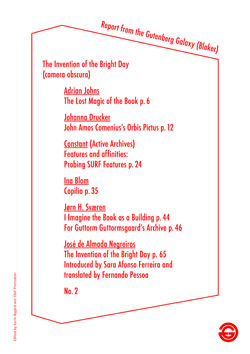
With texts by Wolfgang Ernst, Constant, Guttorm Guttormsgaard, et al. (1), Adrian Johns, Johanna Drucker, Constant, Ina Blom, Jørn H. Sværen, José de Almada Negreiros (2).
Edited by Karin Nygård and Ellef Prestsæter
Publisher Rett Kopi, Blaker, 2015
38 & 90 pages (EN)
via Ellef Prestsæter
Exhibition review: Stian Gabrielsen (Kunstkritikk, 2014, NO).
Interview (Kunstkritikk, NO)
No. 1 (English, 11 MB, PDF)
No. 2 (English, 32 MB, PDF)
No. 1 (Norwegian, 7 MB, PDF)
No. 2 (Norwegian, 19 MB, PDF)
See also third volume.
György Galántai, Julia Klaniczay (eds.): Artpool: The Experimental Art Archive of East-Central Europe (2013)
Filed under book | Tags: · archive, art, art history, artists book, avant-garde, east-central europe, fluxus, mail art, performance, sound poetry, visual poetry
“How could an arts initiative, called Artpool, in the 1970s, in a small corner of the world, in East-Central Europe, become a significant node, a reference point in a worldwide – initially analogue (postal) then digital (online) – network?
How has it been able to validly speak out and address issues and people again and again in the ‘storms’ of history and scientific-technological progress, for more than four decades now?
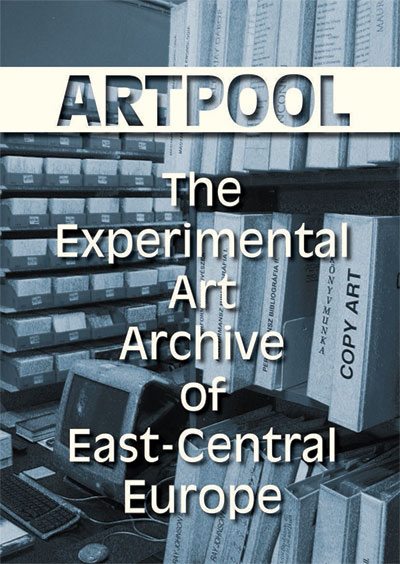
Using authentic documents, numerous photographs and illustrations Artpool’s chronological volume containing a brief presentation of events and exhibitions, a detailed bibliography and references follows the history of the Artpool art project – launched more than forty years ago by fine artist György Galántai and later jointly realized with Júlia Klaniczay – from the exhibitions of the Chapel Studio active in Balatonboglár between 1970 and 1973, through the establishment of the Artpool archive in 1979 to the opening of the Artpool Art Research Center in Budapest in 1992 and its becoming an esteemed research facility by the 2010s.
Hundreds of artists from all corners of the world sent their works to the international Artpool exhibitions, which are built on the “Active Archive” concept and explore themes inspired by our perpetually changing world, in the same way as György Galántai and Artpool also participated in the events organized in the various other nodes of the “Eternal Network”.
The information accumulated in Artpool over the forty years, the collections that were built up, and the research work based on them form the tissue of today’s institute, which beyond the developments in the art scene also informs us about the eventful forty or so years during which Artpool came into being and has continued to operate. This period can be best described by the following keywords: communism, iron curtain, secret files, tapping telephone wires, bans, “the happiest barrack”, samizdat publications, counterculture, change of the system, democratic transition, freedom of the press and speech, independent non-profit initiatives, European Union, strengthening nationalism and conservatism; 20th century, millennium, 21st century; technological and communication explosion.”
Foreword by Kristine Stiles
Publisher Artpool, Budapest, 2013
ISBN 9630872250, 9789630872256
535 pages
PDF (50 MB, updated on 2019-10-29)
Flash