

Christina Dunbar-Hester: Hacking Diversity: The Politics of Inclusion in Open Technology Cultures (2020)
Filed under book | Tags: · care, community, computing, diversity, diy, ethnicity, feminism, floss, gender, hacker culture, hackerspace, hacking, identity, open source, openness, participation, politics, queer, race, technology, women
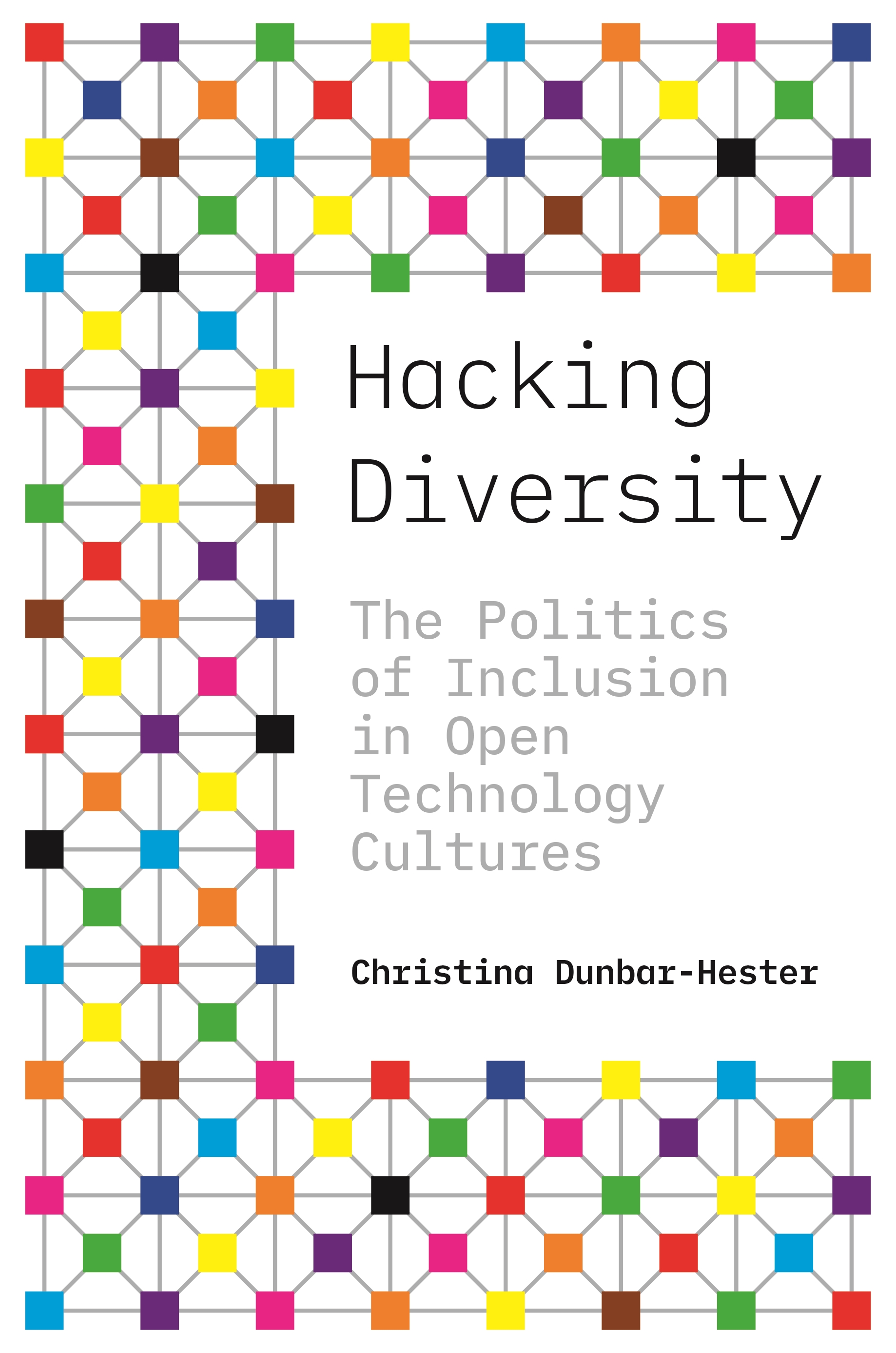
“A firsthand look at efforts to improve diversity in software and hackerspace communities.
Hacking, as a mode of technical and cultural production, is commonly celebrated for its extraordinary freedoms of creation and circulation. Yet surprisingly few women participate in it: rates of involvement by technologically skilled women are drastically lower in hacking communities than in industry and academia. Hacking Diversity investigates the activists engaged in free and open-source software to understand why, despite their efforts, they fail to achieve the diversity that their ideals support.
Christina Dunbar-Hester shows that within this well-meaning volunteer world, beyond the sway of human resource departments and equal opportunity legislation, members of underrepresented groups face unique challenges. She brings together more than five years of firsthand research: attending software conferences and training events, working on message boards and listservs, and frequenting North American hackerspaces. She explores who participates in voluntaristic technology cultures, to what ends, and with what consequences. Digging deep into the fundamental assumptions underpinning STEM-oriented societies, Dunbar-Hester demonstrates that while the preferred solutions of tech enthusiasts—their “hacks” of projects and cultures—can ameliorate some of the “bugs” within their own communities, these methods come up short for issues of unequal social and economic power. Distributing “diversity” in technical production is not equal to generating justice.
Hacking Diversity reframes questions of diversity advocacy to consider what interventions might appropriately broaden inclusion and participation in the hacking world and beyond.”
Publisher Princeton University Press, 2020
Princeton Studies in Culture and Technology series
ISBN 9780691182070, 0691182078
xi+271 pages
Reviews: Jenna P. Carpenter (Tech & Society, 2021), Rebecca Ortenberg (Lady Science, 2020), Samantha Shorey (International Journal of Communication, 2020).
EPUB (updated on 2022-8-29)
PDF (added on 2022-12-12)
Kristoffer Gansing, Inga Luchs (eds.): The Eternal Network: The Ends and Becomings of Network Culture (2020) [EN, DE]
Filed under book | Tags: · federated networks, floss, internet, net culture, network culture, networks
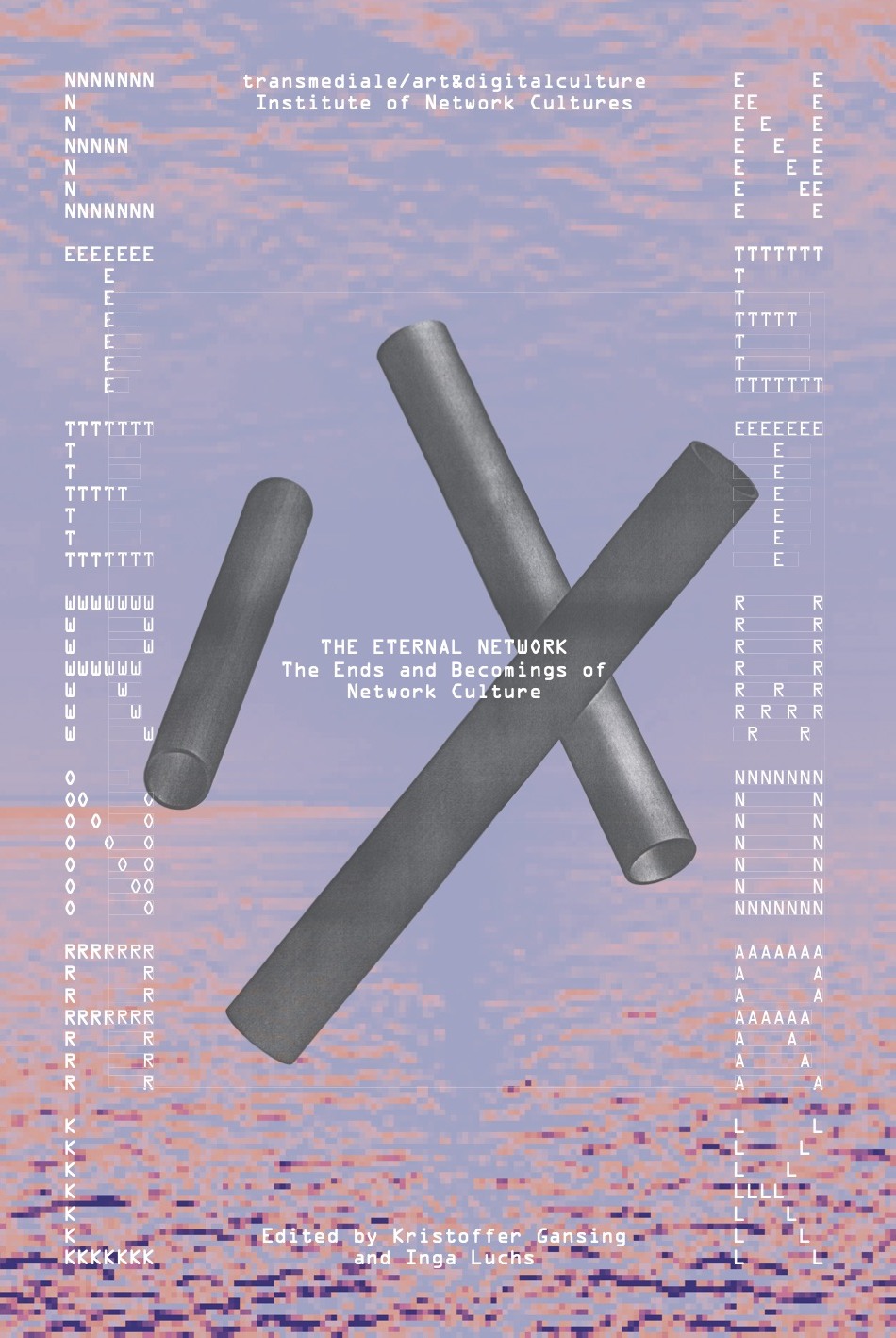
“‘The network is everlasting’ wrote Robert Filliou and George Brecht in 1967, a statement that, at first glance, still seems to be true of today’s world. Yet there are also signs that the omnipresence of networks is evolving into another reality. In recent times, the limits of networks rather than their endless possibilities have been brought into focus. Ongoing media debates about hate speech, fake news, and algorithmic bias swirl into a growing backlash against networks. Perhaps it is time to reconsider the contemporary reach and relevance of the network imaginary.
Accompanying transmediale 2020 End to End’s exhibition ‘The Eternal Network’, this collection gathers contributions from artists, activists, and theorists who engage with the question of the network anew. In referencing Filliou’s eternal notion, the exhibition and publication project closes the loop between pre- and post-internet imaginaries, opening up possible futures with and beyond networks. This calls many of the collection’s authors to turn to instances of independent and critical net cultures as historical points of inspiration for rethinking, reforming, or refuting networks in the present.”
Contributors: Clemens Apprich, Johanna Bruckner, Daphne Dragona, Kristoffer Gansing, Lorena Juan, Aay Liparoto, Geert Lovink, Alessandro Ludovico, Aymeric Mansoux, Rachel O’Dwyer, Luiza Prado de O. Martins, Roel Roscam Abbing, Femke Snelting, and Florian Wüst.
Publisher Institute of Network Cultures, Amsterdam, and transmediale e.V., Berlin, 2020
Creative Commons BY-NC-ND 4.0 International License
ISBN 9789492302465
145 pages
English: PDF, PDF (14 MB), EPUB, EPUB (18 MB), HTML (partial, added on 2020-7-16)
German: PDF, PDF (9 MB, added on 2020-12-4)
Aymeric Mansoux: Sandbox Culture: A Study of the Application of Free and Open Source Software Licensing Ideas to Art and Cultural Production (2017)
Filed under thesis | Tags: · agonism, copyright, cultural production, digital culture, floss, free culture, intellectual property, law, network culture, open source, social movements
“In partial response to the inability of intellectual property laws to adapt to data-sharing over computer networks, several initiatives have proposed techno-legal alternatives to encourage the free circulation and transformation of digital works. These alternatives have shaped part of contemporary digital culture for more than three decades and are today often associated with the “free culture” movement. The different strands of this movement are essentially derived from a narrower concept of software freedom developed in the 1980s, and which is enforced within free and open source software (FLOSS) communities. This principle was the first significant effort to articulate a reusable techno-legal template to work around the limitations of intellectual property laws. It also offered a vision of network culture where community participation and sharing was structural.
From alternate tools and workflow systems, artist-run servers, network publishing experiments, open data and design lobbies, cooperative and collaborative frameworks, but also novel copyright licensing used by both non-profit organisations and for-profit corporations, the impact on cultural production of practices developed in relation to the ideas of FLOSS has been both influential and broadly applied. However, if it is true that FLOSS has indeed succeeded in becoming a theoretical and practical model for the transformation of art and culture, the question remains at which ways it has provided such a model, how it has been effectively appropriated across different groups and contexts and in what ways these overlap or differ.
Using the image of the sandbox, where code becomes a constituent device for different communities to experience varying ideologies and practices, this dissertation aims to map the consequent levels of divergence in interpreting and appropriating the free and open source techno-legal template. This thesis identifies the paradoxes, conflicts, and contradictions within free culture discourse. It explores the tensions between the wish to provide a theoretical universal definition of cultural freedom, and the disorderly reality of its practice and interpretation. However, despite the different layers of cultural diffusion, appropriation, misunderstanding and miscommunication that together form the fabric of free culture, this dissertation argues that, even though feared, fought, and criticised, these issues are not signs of dysfunctionality but are instead the evidence of cultural diversity within free culture. This dissertation will also demonstrate that conflicts between and within these sandboxes create a democratic process that permits the constant transformation of the free and open source discourse, and is therefore something that should be embraced and neither resisted nor substituted for a universal approach to cultural production.”
Includes an anthology of proto-free culture licenses, 1998-2002 (pp 382-452).
PhD Dissertation
Supervisor: Matthew Fuller
Publisher Centre of Cultural Studies, Goldsmiths, University of London, 2017
xxxviii+486 pages
via author