
X-MED-A: Experimental Media Arts (2006)
Filed under book | Tags: · art, code, experimental art, generativity, media art, media ecology, music, performance, software, sound art, sound recording, technology, textile, video, workshop

“In X-MED-A publication you can find more than 40 contributions from a motley crew of artists, designers and engineers, including Matthew Fuller, Joey Berzowska, Casey Reas, Akihiro Kubota along with many other clever and lovely people. The articles, interviews, poems and patches reflect upon education and play, poetics and aesthetics, technology and collaboration, politics and economics of experimental media arts, steeped in a sea of photographs, diagrams, screenshots and illustrations.
The review originated from a series of technically and artistically diverse workshops, organised by four independent technological arts initiatives in Brussels: FoAM, nadine, okno and iMAL. The workshops responded to the needfor a place where continuous learning and dialogue between peers is encouraged, with the objective of sharing of experience, skills and knowledge among diverse groups interested in emerging ideas, media and technologies.”
Contributions by mxhz.org, Guy van Belle, Angez Bewer, Bartaku, Johanna Berzowska, Nicolas Collins, Alejandra Perez Nunez, Akihiro Kubota, Franziska Huebler, Carole Collet, FoAM, Eleonora Oreggia, Casey Reas and Ben Fry, jasch, David Griffiths, Toplap, so-on, Xavier Ess, Els Viaene and Dieter van Dam, Code31, Nadine, Yves Bernard, HC Gilje, Rachel Wingfield, Christoph de Boeck, Isjtar, Nicolas d’Alessandro, Jelle Dierickx, Jenny Tillotson, Jessica Hemmings, Toysband, Alejo Duque, Erik Parys, Pablo Diartinez
With an introduction by Matthew Fuller
Edited by Maja Kuzmanovic (FoAM), nadine, Annemie Maes (okno), Yves Bernard (iMAL)
Assistant editor: Alkan Chipperfield
Publisher: FoAM, nadine, okno, and iMAL, Brussels, 2006
Creative Commons Attribution-NoDerivs 2.5 License
ISBN 908107332X
156 pages
Project website
Editor (FoAM)
PDF (updated on 2021-12-29)
Comment (0)Stephen Wilson: Information Arts: Intersections of Art, Science, and Technology (2002)
Filed under book | Tags: · art, art and science, artificial intelligence, artistic research, bio art, biology, ecology, electronic art, genetics, interactive media, media art, nanotechnology, new media, physics, robots, science, sound art, technology, telepresence, theory
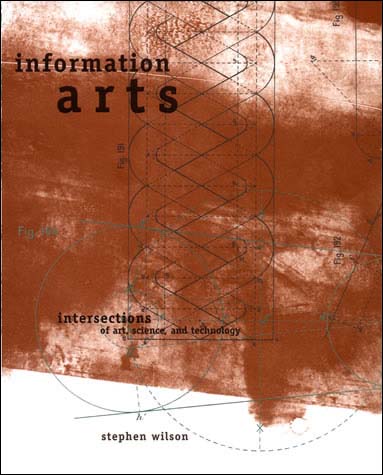
“A new breed of contemporary artist engages science and technology—not just to adopt the vocabulary and gizmos, but to explore and comment on the content, agendas, and possibilities. Indeed, proposes Stephen Wilson, the role of the artist is not only to interpret and to spread scientific knowledge, but to be an active partner in determining the direction of research. Years ago, C. P. Snow wrote about the “two cultures” of science and the humanities; these developments may finally help to change the outlook of those who view science and technology as separate from the general culture.
In this rich compendium, Wilson offers the first comprehensive survey of international artists who incorporate concepts and research from mathematics, the physical sciences, biology, kinetics, telecommunications, and experimental digital systems such as artificial intelligence and ubiquitous computing. In addition to visual documentation and statements by the artists, Wilson examines relevant art-theoretical writings and explores emerging scientific and technological research likely to be culturally significant in the future. He also provides lists of resources including organizations, publications, conferences, museums, research centers, and Web sites.”
Published by MIT Press, 2002
ISBN 026223209X, 9780262232098
969 pages
PDF (updated on 2012-10-23)
Comment (0)