

Janneke Adema: Living Books: Experiments in the Posthumanities (2021)
Filed under book | Tags: · archive, authorship, book, collaboration, community, copyright, hypertext, media, neoliberalism, open access, openness, print, publishing, scholarship, university, versioning, wiki
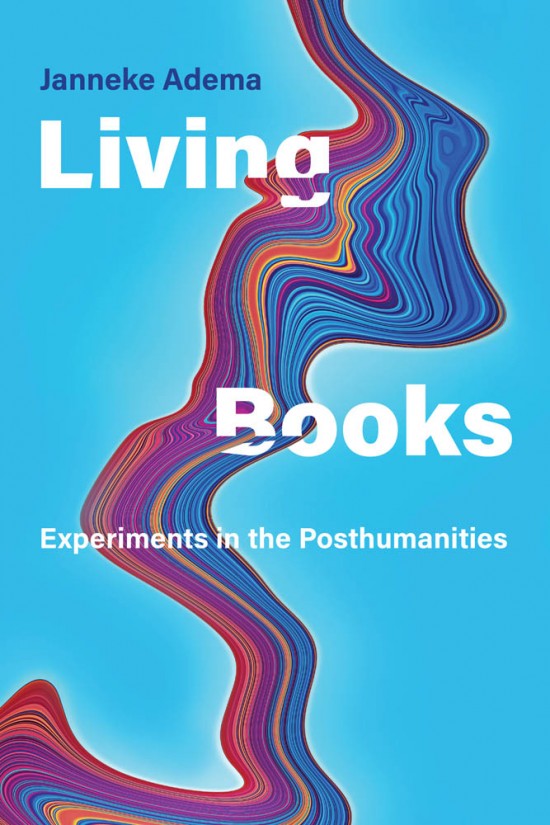
“Reimagining the scholarly book as living and collaborative—not as commodified and essentialized, but in all its dynamic materiality.
In this book, Janneke Adema proposes that we reimagine the scholarly book as a living and collaborative project—not as linear, bound, and fixed, but as fluid, remixed, and liquid, a space for experimentation. She presents a series of cutting-edge experiments in arts and humanities book publishing, showcasing the radical new forms that book-based scholarly work might take in the digital age. Adema’s proposed alternative futures for the scholarly book go beyond such print-based assumptions as fixity, stability, the single author, originality, and copyright, reaching instead for a dynamic and emergent materiality.
Adema suggests ways to unbind the book, describing experiments in scholarly book publishing with new forms of anonymous collaborative authorship, radical open access publishing, and processual, living, and remixed publications, among other practices. She doesn’t cast digital as the solution and print as the problem; the problem in scholarly publishing, she argues, is not print itself, but the way print has been commodified and essentialized. Adema explores alternative, more ethical models of authorship; constructs an alternative genealogy of openness; and examines opportunities for intervention in current cultures of knowledge production. Finally, asking why it is that we cut and bind our research together at all, she examines two book publishing projects that experiment with remix and reuse and try to rethink and reperform the book-apparatus by taking responsibility for the cuts they make.”
Publisher MIT Press, August 2021
Leonardo series
Creative Commons BY-NC 4.0 International License
ISBN 9780262046022, 0262046024
xiii+335 pages
Interview with author: Erzsébet Tóth-Czifra (Dariah Open, 2021).
Comment (0)David Graeber, David Wengrow: The Dawn of Everything: A New History of Humanity (2021)
Filed under book | Tags: · agriculture, bureaucracy, city, critique, history, human, indigenous peoples, politics, production, progress, property, sovereignty
“For generations, our remote ancestors have been cast as primitive and childlike–either free and equal innocents, or thuggish and warlike. Civilization, we are told, could be achieved only by sacrificing those original freedoms or, alternatively, by taming our baser instincts. David Graeber and David Wengrow show how such theories first emerged in the eighteenth century as a conservative reaction to powerful critiques of European society posed by Indigenous observers and intellectuals. Revisiting this encounter has startling implications for how we make sense of human history today, including the origins of farming, property, cities, democracy, slavery, and civilization itself.
Drawing on research in archaeology and anthropology, the authors show how history becomes a far more interesting place once we learn to throw off our conceptual shackles and perceive what’s really there. If humans did not spend 95 percent of their evolutionary past in tiny bands of hunter-gatherers, what were they doing all that time? If agriculture, and cities, did not mean a plunge into hierarchy and domination, then what kinds of social and economic organization did they lead to? The answers are often unexpected, and suggest that the course of human history may be less set in stone, and more full of playful, hopeful possibilities, than we tend to assume.”
Publisher Farrar, Straus and Giroux, November 2021
ISBN 9780374157357, 0374157359
xii+692 pages
Reviews: William Deresiewicz (The Atlantic, 2021), Giulio Ongaro (Jacobin/Tribune, 2021), Jennifer Schuessler (The New York Times, 2021), Kwame Anthony Appiah (The New York Review, 2021), David Priestland (The Guardian, 2021), Emily Kern (Boston Review, 2021), Steve Rushton (Bella Caledonia, 2021), George Scialabba (New Republic, 2021), Chris Knight, Nancy Lindisfarne and Jonathan Neale (Monthly Review, 2021), Tunku Varadarajan (Wall Street Journal, 2021), Erle C. Ellis (Science, 2021), Peter Isackson (Fair Observer, 2021), Noah Berlatsky (NBC News, 2021), Annalee Newitz (Washington Post, 2021), Matthew Porges (LA Review of Books, 2022), Richard Handler (TLS, 2022), anon. (Astral Codex Ten, 2022), Milena Bartlová (A2larm, 2022, CZ), Joe Gill (Middle East Eye, 2023), Jan Bělíček, Eva Klíčová (Alarm, podcast, 2024, CZ), more.
Book website
Publisher
WorldCat
Daniel Fairfax: The Red Years of Cahiers du cinéma, 1968-1973, 2 vols. (2021)
Filed under book | Tags: · 1968, aesthetics, cinema, communism, film, film criticism, film history, film theory, ideology, marxism, politics, theory

“The uprising which shook France in May 1968 also had a revolutionary effect on the country’s most prominent film journal. Under editors Jean-Louis Comolli and Jean Narboni, Cahiers du cinéma embarked on a militant turn that would govern the journal’s work over the next five years. Inspired by Marxist and psychoanalytic theory, the “red years” of Cahiers du cinéma produced a theoretical outpouring that was seminal for the formation of film studies and is still of vital relevance for the contemporary audiovisual landscape.
The Red Years of Cahiers du Cinéma (1968-1973) gives an overview of this period in the journal’s history and its aftermath, combining biographical accounts of the critics who wrote for Cahiers in the post 1968 period with theoretical explorations of their key texts.”
Publisher Amsterdam University Press, Amsterdam, 2021
Film Culture in Transition series
ISBN 9789048543908 (vol. 1), 9789048543915 (vol. 2)
427 & 455 pages
HT Quentin Darcq
Publisher (vol. 1)
Publisher (vol. 2)
OAPEN (vol. 1)
OAPEN (vol. 2)
WorldCat (vol. 1)
WorldCat (vol. 2)
Volume I, Ideology and Politics: PDF, PDF
Volume II, Aesthetics and Ontology: PDF, PDF
See also: Cahiers du Cinéma, vols. 1–4.
Comment (0)