

Aisteach: The Avant-Garde Archive of Ireland (2015–)
Filed under online resource | Tags: · avant-garde, dada, graphic score, ireland, music, noise, occultism, surrealism, tape

A repository and archive for historical documents, recordings, materials and ephemera relating to avant-garde artistic projects in Ireland since the 19th century.
Edited by Jennifer Walshe
Comment (0)Roman Jakobson: My Futurist Years (1992/1997)
Filed under book | Tags: · 1910s, 1920s, biography, dada, formalism, futurism, language, linguistics, literary theory, literature, poetics, poetry, slavic studies

“Born in Moscow in 1896, Roman Jakobson was a founder of and a key figure in two influential schools of 20th century literary thought: Russian formalism, and later, during his years in Prague, structuralism. Forced to flee the invading Nazis, Jakobson spent time in Denmark, Norway, and Sweden, before coming to the United States in 1941. During his long and illustrious academic career in the U.S., Jakobson was a professor of literature and linguistics at Columbia, Harvard and MIT. Up to his death in 1982, he published 500 monographs and articles on linguistics, Slavic studies, poetics, and semiotics.
Vital as the extraordinary innovative and turbulent period that spawned these writings, My Futurist Years is one of the most important reflections on the Russian Futurist movement and a cornerstone in the career of one of the century’s greatest linguistic and literary thinkers.
Jakobson’s rare sensibility in his explorations in language and art are no more evident than in this volume, detailing the formative moment in his public and personal life. Along with the quite moving recollections of his friendships with such Modernist figures as Mayakovsky, Khlebnikov, and Malevich, the book includes Jakobson’s letters to other Futurists active in the scene and to his close friend Elsa Brik, later to gain notoriety as the French writer Elsa Triolet and wife of the poet Louis Aragon.” (from the back cover)
First published in Russian as Jakobson-budetljanin: sbornik materialov, Almqvist & Wiksell International, Stockholm, 1992.
Compiled and Edited by Bengt Jangfeldt
Translated and with an Introduction by Stephen Rudy
Publisher Marsilio, New York, 1997
ISBN 0941419797
371 pages
in the Unlimited Edition
Review: Avril Pyman (Slavonic & East European Review, 1993).
PDF (21 MB, updated on 2019-9-27)
Comment (0)Kurt Schwitters, Käte Steinitz, Theo van Doesburg: Die Scheuche: Märchen (1925–) [DE, EN, ES]
Filed under artist publishing, children's book | Tags: · dada, de stijl, graphic design, typography
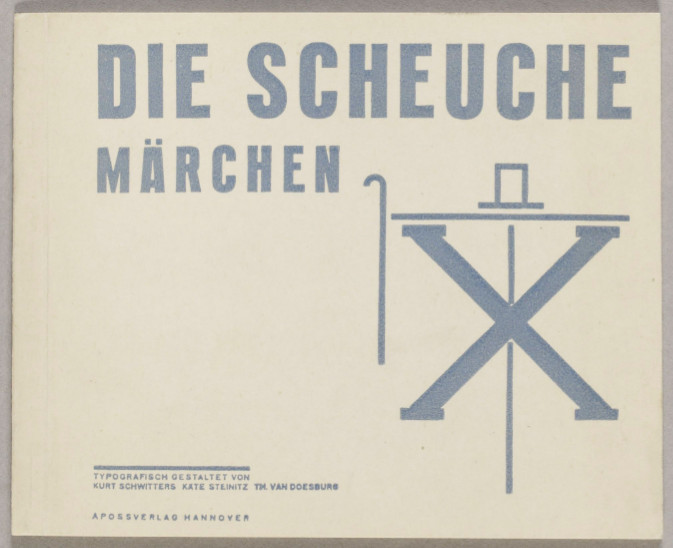
“In Die Scheuche: Märchen [The Scarecrow: A Fairytale] phrasing borrowed from German fairytales, grammar lessons, and religious texts combine into a formal hybrid that is cast in type. For the creators of this children’s book, such serious play with ready-made genres and print components offered a means of collecting the fragments of the past and assembling them to rebuild for the future. The narrative itself thematizes this pursuit: “once upon a time” there was a scarecrow well-appointed in the accoutrements of bourgeoisie comfort, complete with frockcoat, lace scarf, and cane. He is mocked by fowl and beaten by the farmer who made him. A child then pries the cane from the farmer (who has stolen it from the scarecrow) and with a single blow dismantles the order of ownership. The story ends with the ghosts of the items’ erstwhile owners arriving to reclaim their effects.” (Source)
Publisher Apossverlag, Hannover, 1925
12 pages, 13 x 16 cm
via Kunsthaus Zurich
Commentary: Leslie Atzmon (Design Issues, 1996)
Die Scheuche: Märchen (German, 1925, 22 MB, updated on 2020-9-5)
The Scarecrow (English, trans. Jack Zipes, typogr. Barrie Tullet, 2009, partial view on Google Books)
El espantapajaros. Cuento (Spanish, 2012, added on 2017-10-3)