

Margit Rosen, et al. (eds.): A Little-Known Story About a Movement, a Magazine, and The Computer’s Arrival in Art: New Tendencies and Bit International, 1961-1973 (2011)
Filed under book, catalogue | Tags: · 1960s, 1970s, art and science, art history, artistic research, computer art, computing, conceptual art, concrete art, constructivism, cybernetics, design, kinetic art, media art, new tendencies, op art, yugoslavia
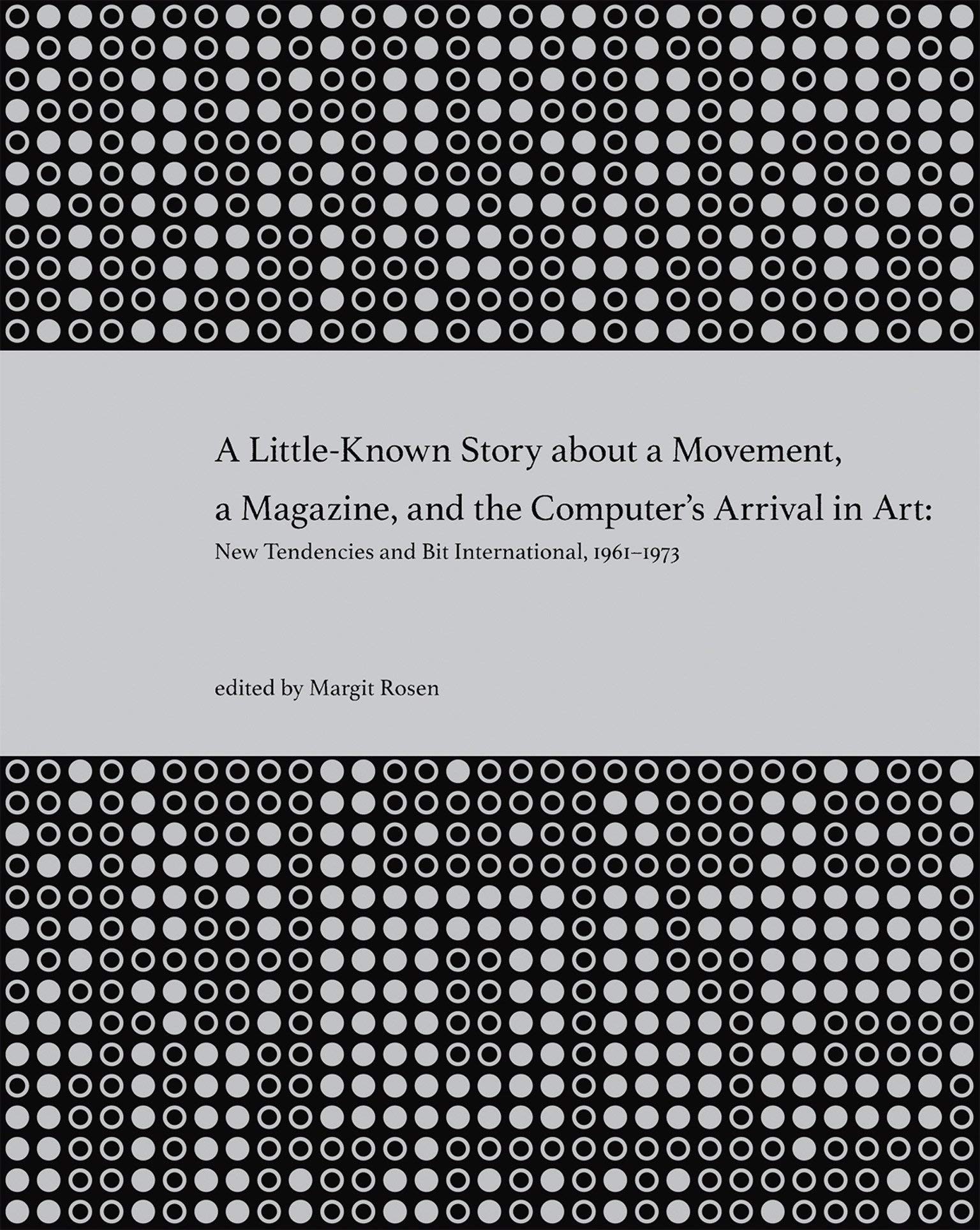
“When Zagreb was the epicenter of explorations into the aesthetic potential of the new “thinking machines.”
This book documents a short but intense artistic experiment that took place in Yugoslavia in the 1960s and 1970s but has been influential far beyond that time and place: the “little-known story” of the advent of computers in art. It was through the activities of the New Tendencies movement, begun in Zagreb in 1961, and its supporting institution the Galerija suvremene umjetnosti that the “thinking machine” was adopted as an artistic tool and medium. Pursuing the idea of “art as visual research,” the New Tendencies movement proceeded along a path that led from Concrete and Constructivist art, Op art, and Kinetic art to computer-generated graphics, film, and sculpture.
With their exhibitions and conferences and the 1968 launch of the multilingual, groundbreaking magazine Bit International, the New Tendencies transformed Zagreb—already one of the most vibrant artistic centers in Yugoslavia—into an international meeting place where artists, engineers, and scientists from both sides of the Iron Curtain gathered around the then-new technology. For a brief moment in time, Zagreb was the epicenter of explorations of the aesthetic, scientific, and political potential of the computer.
This volume documents that exhilarating period. It includes new essays by Jerko Denegri, Darko Fritz, Margit Rosen, and Peter Weibel; many texts that were first published in New Tendencies exhibition catalogs and Bit International magazine; and historic documents. More than 650 black-and-white and color illustrations testify to the astonishing diversity of the exhibited artworks and introduce the movement’s protagonists. Many of the historic photographs, translations, and documents are published here for the first time. Taken together, the images and texts offer the long overdue history of the New Tendencies experiment and its impact on the art of the twentieth century.”
Edited by Margit Rosen in collaboration with Peter Weibel, Darko Fritz, and Marija Gattin
Publisher ZKM Center for Art and Media, Karlsruhe, and MIT Press, Cambridge, MA, 2011
ISBN 9780262515818, 0262515814
576 pages
Reviews: Brian Reffin Smith (Leonardo, 2012), Joanna Inglot (Slavic Review, 2012), Greg Borman (ARLIS/NA, 2011).
Book website
Exhibition (ZKM, 2008)
Publisher
Publisher
WorldCat
PDF (102 MB)
See also New Tendencies and Bit International on Monoskop wiki.
Comment (1)Eglė Rindzevičiūtė: The Power of Systems: How Policy Sciences Opened Up the Cold War World (2016)
Filed under book | Tags: · biosphere, cold war, computing, cybernetics, environment, governmentality, history of science, networks, politics, secrecy, soviet union, systems science, systems theory

“In The Power of Systems, Eglė Rindzevičiūtė introduces readers to one of the best-kept secrets of the Cold War: the International Institute of Applied Systems Analysis (IIASA), an international think tank established by the U.S. and Soviet governments to advance scientific collaboration. From 1972 until the late 1980s IIASA in Austria was one of the very few permanent platforms where policy scientists from both sides of the Cold War divide could work together to articulate and solve world problems. This think tank was a rare zone of freedom, communication, and negotiation, where leading Soviet scientists could try out their innovative ideas, benefit from access to Western literature, and develop social networks, thus paving the way for some of the key science and policy breakthroughs of the twentieth century.
Ambitious diplomatic, scientific, and organizational strategies were employed to make this arena for cooperation work for global change. Under the umbrella of the systems approach, East-West scientists co-produced computer simulations of the long-term world future and the anthropogenic impact on the environment, using global modeling to explore the possible effects of climate change and nuclear winter. Their concern with global issues also became a vehicle for transformation inside the Soviet Union. The book shows how computer modeling, cybernetics, and the systems approach challenged Soviet governance by undermining the linear notions of control on which Soviet governance was based and creating new objects and techniques of government.”
Publisher Cornell University Press, Ithaca, NY, 2016
Creative Commons BY-NC-ND 4.0 International License
ISBN 9781501703188, 1501703188
xi+292 pages
Reviews: Roundtable: Barbara Czarniawska, Jenny Andersson, Claudia Aradau, Paul Rubinson, author’s response (H-Diplo, 2019), Kristine C. Harper (Isis, 2018), Benjamin Peters (Slavic Review, 2019), Gerald Easter (American Historical Review, 2018), Jeanne Morefield (J History of Ideas, 2020), Laurent Coumel (Cahiers du monde russe, 2018, FR), Una Bergmane (Lithuanian Historical Studies, 2018), Christian Dayé (Serendipities, 2018).
PDF (19 MB)
Comment (0)John Beck, Ryan Bishop: Technocrats of the Imagination: Art, Technology, and the Military-Industrial Avant-Garde (2020)
Filed under book | Tags: · art and science, art history, avant-garde, bauhaus, cold war, cybernetics, democracy, liberalism, military, technology, war

“In Technocrats of the Imagination John Beck and Ryan Bishop explore the collaborations between the American avant-garde art world and the military-industrial complex during the 1960s, in which artists worked with scientists and engineers in universities, private labs, and museums. For artists, designers, and educators working with the likes of Bell Labs, the RAND Corporation, and the Los Angeles County Museum of Art, experiments in art and technology presaged not only a new aesthetic but a new utopian social order based on collective experimentation. In examining these projects’ promises and pitfalls and how they have inspired a new generation of collaborative labs populated by artists, engineers, and scientists, Beck and Bishop reveal the connections between the contemporary art world and the militarized lab model of research that has dominated the sciences since the 1950s.”
Publisher Duke University Press, Durham, 2020
Cultural Politics series
ISBN 9781478005957, 1478005955
viii+229 pages
Review: Lindsay Caplan (Art in America, 2020).
PDF, PDF (updated on 2022-1-16)
Comment (0)