

Stéphane Mallarmé: A Throw of Dice Will Never Abolish Chance (1897–) [FR, PT, ES, IT, EN]
Filed under poetry | Tags: · poetry, typography, visual poetry
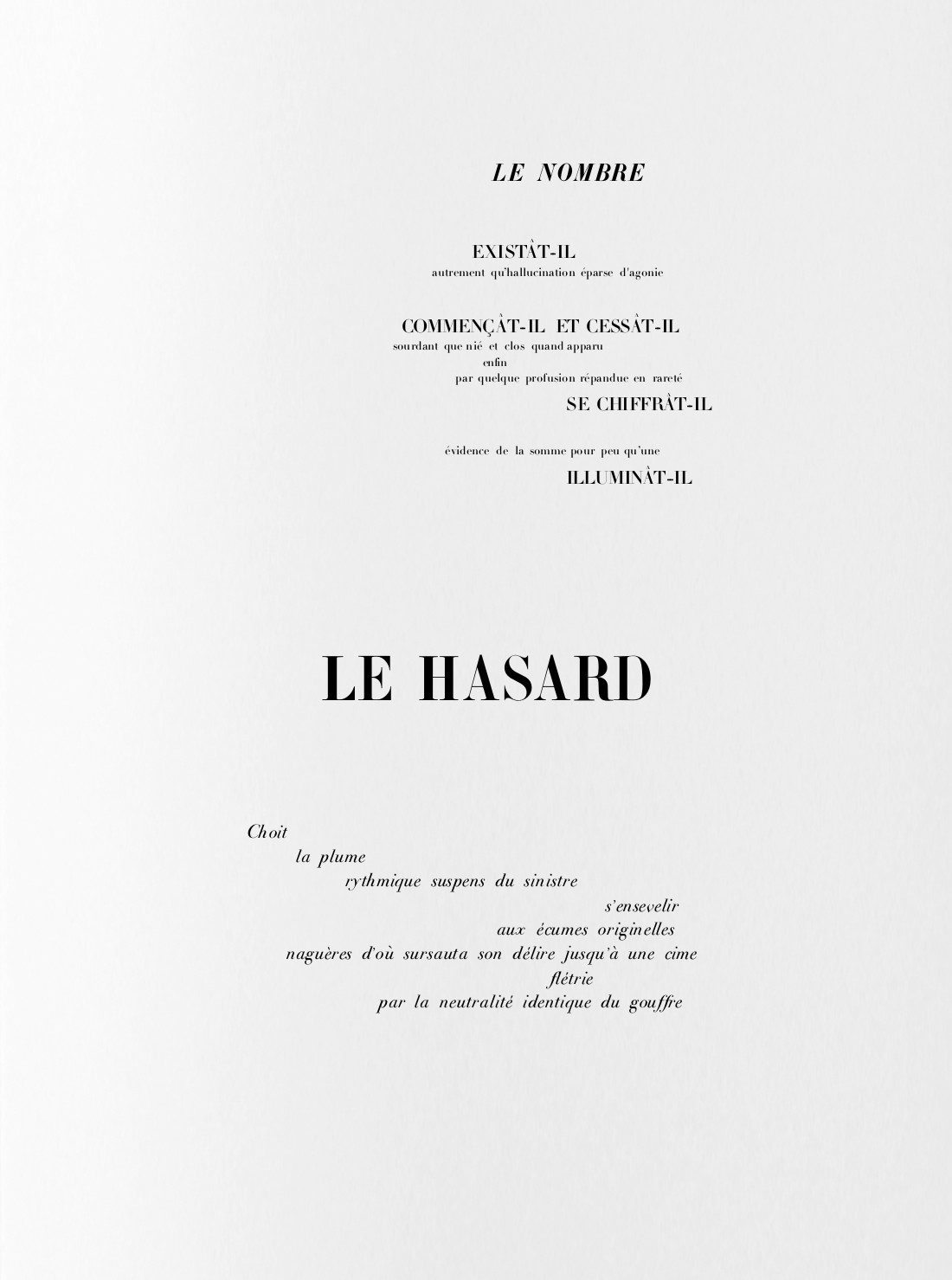
Un coup de Dés jamais n’abolira le Hasard is one of the most well-known works of the French Symbolist poet Stéphane Mallarmé.
In 1874, Mallarmé made his early mark in the field of “graphic design by creating single-handedly one of the first fashion journals, La Dernière mode, which ran for six issues. Consequently, he began around this time to take notes on what he considered to be his ultimate poetic project, the publication of what he called ‘the Book’, a poetic object that would replace the Bible as a central figure in a sort of secular art/religious ritual. While the Book was never fully realized, Mallarmé’s increasing concern over the ‘crisis in verse’ — basically, the arrival of free verse in France, and the untoward retirement of the much-loved alexandrine — led him to conceive the 12 pages of Un coup de dés, whose words spill across the pages like stars strewn across the sky or, indeed, like throws of the dice. Mallarmé’s fellow Symbolist Paul Valéry wrote a memorable description of first seeing the poem in The Master’s workshop:
‘It seemed to me that I was looking at the form and pattern of a thought, placed for the first time in finite space. Here space itself truly spoke, dreamed, and gave birth to temporal forms. Expectancy, doubt, concentration, all were visible things. With my own eye I could see silences that had assumed bodily shapes. Inappreciable instants became clearly visible: the fraction of a second during which an idea flashes into being and dies away; atoms of time that serve as the germs of infinite consequences lasting through psychological centuries — at last these appeared as beings, each surrounded with a palpable emptiness [..] There in the same void with them, like some new form of matter arranged in systems or masses or trailing lines, coexisted the Word!’
Like many readers of Un coup de dés, Valéry thought he was gazing on a poem that reflected an improvisatory air: a map of a human mind, not to mention a chart through “psychological centuries.” The heroic nature of Mallarmé’s achievement, of a sort that seems decidedly unfashionable in poetry today, is palpable in Valéry’s breathless encomium. The poem has since been seen as one of the most successful typographical achievements ever, harbinger of the experiments of the Futurists and Dadaists, not to mention the mesostics of John Cage, Brazilian concrete poetry, Flash and animated poetry, and interactive iPad apps like Jörg Piringer’s whimsical ‘abcdefghijklmnopqrstuvwxyz’.” (from Brian Kim Stefans’ review of Meillassoux’s The Number of the Siren)
First published in Cosmopolis: Revue internationale 4(17), May 1897
Publisher Armand Colin, Paris
Pages 417-427
via Gallica.fr
Un coup de dés in PEPC Library (with an English translation of Mallarmé’s Preface of 1897)
Wikipedia (English)
Jamais un Coup de Dés n’abolira le Hasard (French, manuscript, 1897, from Maldoror ediciones)
Un Coup de Dés jamais n’abolira le Hasard (French, 1897, first print)
Un coup de Dés jamais n’abolira le Hasard (French, 1897/1914), spreads (from PEPC Library)
Un coup de Dés jamais n’abolira le Hasard (French, ed. Michel Pierson, 1897/2004, from Michel Pierson & Ptyx, an edition reconstructing Mallarmé’s intended layout)
Um Lance de Dados Jamais Abolirá o Acaso (Portuguese, trans. Haroldo de Campos, 1975/1991)
Jugada de dados (Spanish/French, trans. Federico Gorbea, 1982)
Un tiro di dadi mai abolirà il caso (Italian, trans. Enrico Pozzi, 2002)
Un Tratto di Dadi mai abolirà il Caso (Italian, trans. Francesco Piselli, 2003)
A Throw of the Dice Never Will Abolish Chance (English, trans. Basil Cleveland, 2005, from UbuWeb)
A Fluke (English, a mistranslation by Chris Edwards, 2005, HTML, from Jacket2)
One Toss of the Dice Never Will Abolish Chance (English, trans. Christopher Mulrooney, undated, HTML, from UbuWeb)
A Dice Throw At Any Time Never Will Abolish Chance (English, trans. E.H. and A.M. Blackmore, 2006)
A Throw of the Dice Will Never Abolish Chance (English, trans. A.S. Kline, 2007, multiple formats)
A Throw of Dice Will Never Abolish Chance (English, trans. Robin Mackay, 2012)
Um lance de Dados jamás abolirá el Azar (Spanish, trans. Jorge Segovia, 2013)
See also Marcel Broodthaers’ rendering of the poem, 1969 (French)
and Quentin Meillassoux’s The Number and the Siren, 2011/2012 (French, English)
Guillaume Apollinaire: Calligrammes: Poems of Peace and War, 1913–1916 (1918–) [FR, CZ, RU, EN, ES]
Filed under poetry | Tags: · concrete poetry, poetry, typography, visual poetry
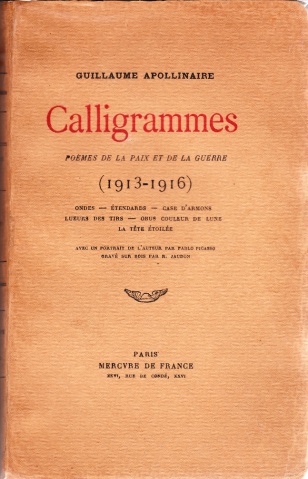
Calligrammes is a key work not only in Apollinaire’s own development but in the evolution of modern French poetry. Apollinaire–Roman by birth, Polish by name (Wilhelm-Apollinaris de Kostrowitski), Parisian by choice–died at thirty-eight in 1918. Nevertheless, he became one of the leading figures in twentieth-century poetry, a transitional figure whose work at once echoes the Symbolists and anticipates the work of the Surrealists.
Apollinaire described calligrams as “an idealisation of free verse poetry and typographical precision in an era when typography is reaching a brilliant end to its career, at the dawn of the new means of reproduction that are the cinema and the phonograph.” (from a letter to André Billy, quoted in a preface to the 1966 French edition by Michel Butor)
French edition
With a portrait of the author by Pablo Picasso
Publisher Mercvre de France, Paris, 1918
205 pages
English/French bilingual edition
Translated by Anne Hyde Greet
With an Introduction by S.I. Lockerbie
Commentary by Anne Hyde Greet and S.I. Lockerbie
Publisher University of California Press, 1980
ISBN 0520242122, 9780520242128
513 pages
Apollinaire in UbuWeb Sound
Wikipedia (EN)
Publisher (EN)
Calligrammes, poèmes de la paix et de la guerre 1913-1916 (via Gallica.BNF.fr)
Kaligramy (Czech, trans. Karel and Miloslav Baláš, 1948, incomplete)
Stikhi (includes “Kalligrammy”, pp 99-150, Russian, trans. M. Koudinov, 1967, DJVU)
Calligrammes: Poems of Peace and War (1913-1916) (English/French, trans. Anne Hyde Greet, 1980, from UbuWeb)
Kalligrammy. Stikhotvoreniya mira i voyny 1913-1916 (Russian, 1999, TXT)
Caligramas: Poemas de la paz y de la guerra (1913-1916) (Spanish, trans. José Ignacio Velazquez, 1987, selection)
Idéogrammes (Spanish translation of Et moi aussi je suis peintre by Jorge Segovia, 2012)
Josef Hiršal, Bohumila Grögerová (eds.): Slovo, písmo, akce, hlas: K estetice kultury technického věku (1967) [Czech]
Filed under book | Tags: · aesthetics, art, art theory, avant-garde, chance, computer art, concrete poetry, experimental art, fluxus, happening, kinetic art, lettrism, literary theory, manifesto, music theory, poetry, technology, visual poetry

A unique anthology of essays, manifestos and artistic programs from the period 1950-1965 by Jasia Reichardt, George Brecht, George Maciunas, Ben Vautier, Eugen Gomringer, Décio Pignatari, Max Bense, Umberto Eco, and others.
“Tento sborník teoretických studií, esejů, článků a uměleckých manifestů napsaných v prvních patnácti letech druhé poloviny dvacátého století, chce být v prvé řade informací. Informací o estetice toho, co bývá globálně nazýváno experimentálním uměním, vznikajícím v technické civilizaci a realizujícím rozličné tendence a programy v různých částech světa. Chce osvětlit tento pojem a poukázat na rozdílnost jeho aplikací i výkladů. Navíc pak chce poskytnout v českém překladu přímo pramenné materiály o nových druzích poezie (o poezii umělé, konkrétní, auditivní, verbofonické, grafické), o umění lettristickém, permutacionálním, totálním, o splývaní dosud samostatných uměleckých disciplín a žánrů i o krystalizaci a výskytu nových, reprezentovaných především akcemi (happening aj.).
Ve sborníku je zařazeno vedle statí, studií a manifestů uměleckých skupin, teoretiků i samotných umělců i několik přehledů historických a vývojových, ukazujících souvislosti současného umění s etapami předchozími a podávajících další důkazy o jeho univerzalitě i diferenciaci. Materiály sborníku netvoří ani v náznaku kompaktní celek. Jsou spíše jednotlivými, někdy dokonce přímo si odporujícími hlasy vzrušeného rozhovoru, vytvářejí konglomerát různých tendencí, názorů a reakcí na skutečnost a stav civilizace druhé poloviny našeho století v rozdílných společenských podmínkách. Záměřem pořadatelů bylo přiblížit je našim zasvěcenějším i laickým čtenářům a poskytnout tak hlubší předpoklady k vnímání současných uměleckých artefaktů i k pochopení jejich metodologie.
Shrnutím nejvýraznějších, mnohdy však i nejproblematičtějších současných estetických tendencí představuje tento sborník materiál, který — právě snad pro svou názorovou diferenciaci, rozpornost a nesmiřitelnost — nemá dosud ve světě obdoby. Bylo by si proto jen přát, aby se názorům a informacím v něm obsaženým dostalo žádoucího doplnění ve zpřístupnění korespondujících konkrétních uměleckých výtvorů jak světové, tak i naší skromnější provecience, resp. v pokračujícím zpřístupňování, protože mnohé již u nás známe jsou. Padly by tak poslední falešné mýty a představy — a to jak ze strany snobů, tak diletantů — a byla by i v této oblasti dokořán otevřena cesta k přirozenému a nevyhnutelnému vývojovému výběru.” (from the Introduction)
With an Afterword by Jiří Levý
Publisher Československý spisovatel, Prague, 1967
Volume 1 of Monoskop Unlimited Edition series
256 pages
PDF (40 MB, no OCR)
Comment (0)