

Differences 22(2-3): The Sense of Sound (2011)
Filed under journal | Tags: · acoustics, cybernetics, hearing, noise, science, sound, sound studies, voice

“Sound has given rise to many rich theoretical reflections, but when compared to the study of images, the study of sound continues to be marginalized. How is the “sense” of sound constituted and elaborated linguistically, textually, technologically, phenomenologically, and geologically, as well as acoustically? How is sound grasped as an object? Considering sound both within and beyond the scope of the human senses, contributors from literature, film, music, philosophy, anthropology, media and communication, and science and technology studies address topics that range from Descartes’s resonant subject to the gendering of hearing physiology in the nineteenth century, Cold War politics and the opera Nixon in China, sounds from the Mediterranean, the poetics of signal processing, and the acousmatic voice in the age of MP3s. In the interpretive challenges posed by voice, noise, antinoise, whispering, near inaudibility, and silence and in the frequent noncoincidence of emission and reception, sound confronts us with what might be called its inhuman qualities—its irreducibility to meaning, to communication, to information, and even to recognition and identification.”
Contributors: Caroline Bassett, Eugenie Brinkema, Iain Chambers, Michel Chion, Rey Chow, Mladen Dolar, Veit Erlmann, Evan Johnson, Christopher Lee, Mara Mills, John Mowitt, Dominic Pettman, Tara Rodgers, Nicholas Seaver, James A. Steintrager, Jonathan Sterne.
Special double-issue of Differences: A Journal of Feminist Cultural Studies
Guest edited by Rey Chow and James A. Steintrager
Publisher Duke University Press
ISSN 1040-7391
314 pages
via -end-
James R. Beniger: The Control Revolution: Technological and Economic Origins of the Information Society (1986)
Filed under book | Tags: · advertising, agriculture, bureaucracy, computing, cybernetics, economy, energy, history of technology, industrial revolution, industry, information society, management, mass media, radio, society, technology, telegraphy, telephone, television, transport
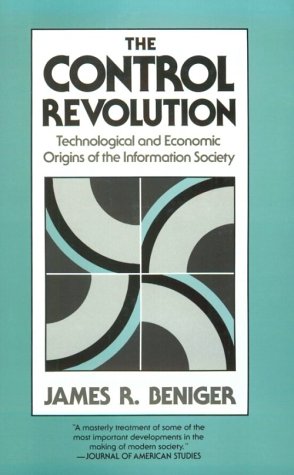
“James Beniger traces the origin of the Information Society to major economic and business crises of the past century. In the United States, applications of steam power in the early 1800s brought a dramatic rise in the speed, volume, and complexity of industrial processes, making them difficult to control. Scores of problems arose: fatal train wrecks, misplacement of freight cars for months at a time, loss of shipments, inability to maintain high rates of inventory turnover. Inevitably the Industrial Revolution, with its ballooning use of energy to drive material processes, required a corresponding growth in the exploitation of information: the Control Revolution.
Between the 1840s and the 1920s came most of the important information-processing and communication technologies still in use today: telegraphy, modern bureaucracy, rotary power printing, the postage stamp, paper money, typewriter, telephone, punch-card processing, motion pictures, radio, and television. Beniger shows that more recent developments in microprocessors, computers, and telecommunications are only a smooth continuation of this Control Revolution. Along the way he touches on many fascinating topics: why breakfast was invented, how trademarks came to be worth more than the companies that own them, why some employees wear uniforms, and whether time zones will always be necessary.”
Publisher Harvard University Press, 1986
ISBN 0674020766, 9780674020764
493 pages
via babyalanturing
Review (JoAnne Yates, The Journal of Interdisciplinary History, 1988)
Review (Krishan Kumar, Journal of American Studies, 1988)
Review (Kirkus Reviews)
Book-inspired website
Publisher
PDF (16 MB, updated on 2016-6-16)
Comment (0)W. J. T. Mitchell, Mark B. N. Hansen (eds.): Critical Terms for Media Studies (2010)
Filed under book | Tags: · aesthetics, autopoiesis, body, communication, cybernetics, image, information theory, language, law, mass media, media, media studies, media theory, memory, networks, posthuman, software, technology, writing

“Part of a larger conversation that engages culture, technology, and politics, this collection of essays explores critical language for dealing with the qualities and modes of contemporary media. The essays, commissioned expressly for this volume, are organized into three interrelated groups: “Aesthetics” engages with terms that describe sensory experiences and judgments, “Technology” offers entry into a broad array of technological concepts, and “Society” opens up language describing the systems that allow a medium to function.”
Contributors: Johanna Drucker (Art), Bernadette Wegenstein (Body), Bill Brown (Materiality), Bernard Stiegler (Memory), Caroline Jones (Senses), Eugene Thacker (Biomedia), Bruce Clarke (Communication, Information), N. Katherine Hayles (Cybernetics), Geoffrey Winthrop-Young (Hardware / Software / Wetware), John Johnston (Technology), David Graeber (Exchange), Cary Wolfe (Language), Peter Goodrich (Law), John Durham Peters (Mass Media), Alexander R. Galloway (Networks), David Wellbery (Systems), Lydia H. Liu (Writing), and W. J. T. Mitchell and Mark B. N. Hansen (Image, Time and Space, New Media).
Publisher University of Chicago Press, 2010
ISBN 0226532666, 9780226532660
376 pages