

Gwen Allen: Artists’ Magazines: An Alternative Space for Art (2011)
Filed under book | Tags: · art, artists book, conceptual art, fluxus, magazine, mail art, photography, poetry, publishing
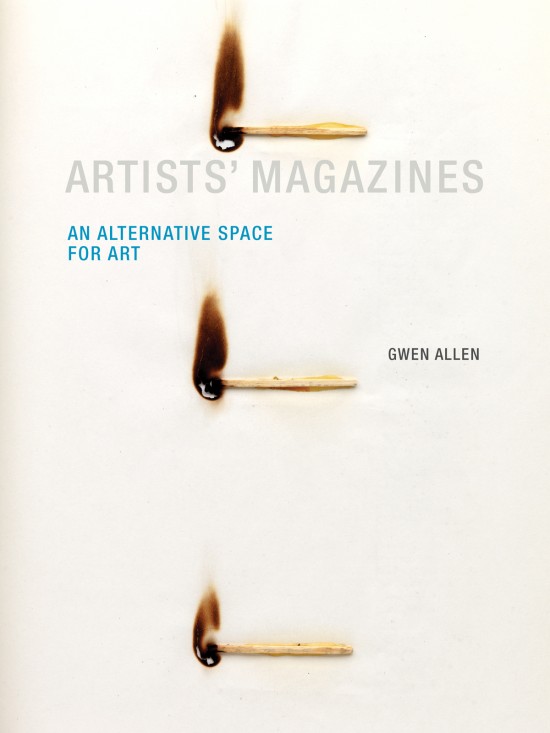
“Magazine publishing is an exercise in ephemerality and transience; each issue goes out in the world only to be rendered obsolete by the next. To publish a magazine is to enter into a heightened relationship with the present moment. During the 1960s and 1970s, magazines became an important new site of artistic practice, functioning as an alternative exhibition space for the dematerialized practices of conceptual art. Artists created works expressly for these mass-produced, hand-editioned pages, using the ephemerality and the materiality of the magazine to challenge the conventions of both artistic medium and gallery. In Artists’ Magazines, Gwen Allen looks at the most important of these magazines in their heyday (the 1960s to the 1980s) and compiles a comprehensive, illustrated directory of hundreds of others.
Among the magazines Allen examines are Aspen (1965–1971), a multimedia magazine in a box—issues included Super-8 films, flexi-disc records, critical writings, artists’ postage stamps, and collectible chapbooks; Avalanche (1970-1976), which expressed the countercultural character of the emerging SoHo art community through its interviews and artist-designed contributions; Art-Rite (1973-1978), an irreverent zine with a disposable, newsprint format; Real Life (1979-1994), published by Thomas Lawson and Susan Morgan as a forum for the Pictures generation; 0 to 9 (1967–1969), a mimeographed poetry magazine founded by Vito Acconci and Bernadette Meyer; FILE (1972–1989), founded by the Canadian collective General Idea, its cover design a sly parody of Life magazine; and Interfunktionen (1968–1975), founded to protest the conservative curatorial strategies of Documenta. These and the other magazines Allen examines expressed their differences from mainstream media in both form and content: they cast their homemade, DIY quality against the slickness of an Artforum, and they created work that defied the formalist orthodoxy of the day. (A work by John Baldessari from the late 1960s shows a photograph of Artforum, captioned “THIS IS NOT TO BE LOOKED AT.”) Artists’ Magazines, featuring abundant color illustrations of magazine covers and content, offers an essential guide to a little-explored medium.”
Publisher MIT Press, 2011
ISBN 0262015196, 9780262015196
300 pages
Reviews: Maarten van Gageldonk (Tijdschrift voor Tijdschriftstudies, 2012), Lucy Mulroney (West 86th, 2012), Alexander Provan (Bidoun, 2011), Dave Dyment (Magenta, 2012), Guy Crucianelli (PopMatters, 2011).
PDF (removed on 2018-8-20 upon request from publisher)
Comment (0)Juan Downey: El ojo pensante / The Thinking Eye (2010) [Spanish/English]
Filed under catalogue | Tags: · art, art history, cybernetics, electronic art, photography, video, video art
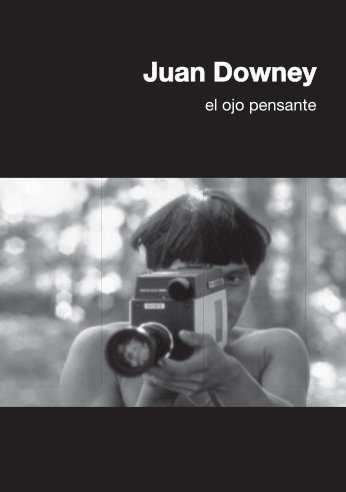
Catalogue of the exhibition of a US-based Chilean pioneer video artist. During his career Downey created an extensive body of work that also includes electronic and video sculptures, photography, painting, drawing, printmaking, performance, installation and writing.
Curated by Julieta Gonzalez
Co-curated and Edited by Marilys Belt de Downey
Texts by Carla Macchiavello, Valerie Smith, Julieta Gonzalez, Nicolas Guagnini
227 pages
PDF (English section pp 173-217; 4 MB, updated on 2014-9-14)
Comment (0)Jacques Khalip, Robert Mitchell (eds.): Releasing the Image: From Literature to New Media (2011)
Filed under book | Tags: · acoustics, aesthetics, art, audiovisual, biopolitics, cinema, critique, image, literature, new media, new media art, phenomenology, philosophy, photography, sound recording, theory, video

“It has become a commonplace that “images” were central to the twentieth century and that their role will be even more powerful in the twenty-first. But what is an image and what can an image be? Releasing the Image understands images as something beyond mere representations of things. Releasing images from that function, it shows them to be self-referential and self-generative, and in this way capable of producing forms of engagement beyond spectatorship and subjectivity. This understanding of images owes much to phenomenology—the work of Husserl, Heidegger, and Merleau-Ponty—and to Gilles Deleuze’s post-phenomenological work. The essays included here cover historical periods from the Romantic era to the present and address a range of topics, from Cézanne’s painting, to images in poetry, to contemporary audiovisual art. They reveal the aesthetic, ethical, and political stakes of the project of releasing images and provoke new ways of engaging with embodiment, agency, history, and technology.”
With contributions by Peter Geimer, Jean-Luc Marion, Giorgio Agamben, Mark B.N. Hansen, Vivian Sobchack, Timothy Murray, Cesare Casarino, Kenneth Surin, Forest Pyle, Kevin McLaughlin, Bernard Stiegler
Publisher Stanford University Press, 2011
ISBN 0804761388, 9780804761383
304 pages
PDF (updated on 2019-10-7)
Comments (2)