

Bruce Sterling: The Hacker Crackdown: Law and Disorder on the Electronic Frontier (1992–) [EN, ES, CZ]
Filed under book | Tags: · cyberspace, hacker culture, hacking, software, telephone
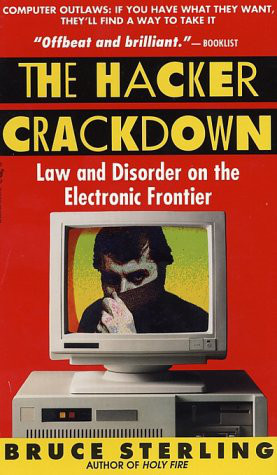
“The AT&T long-distance network crashes, and millions of calls go unanswered. A computer hacker reprograms a switching station, and calls to a Florida probation office are shunted to a New York phone-sex hotline. An underground computer bulletin board publishes a pilfered BellSouth document on the 911 emergency system, making it available to anyone who dials up. How did so much illicit power reach the hands of an undisciplined few – and what should be done about it?
The book discusses watershed events in the hacker subculture in the early 1990s. The most notable topic covered is Operation Sundevil and the events surrounding the 1987-1990 war on the Legion of Doom network: the raid on Steve Jackson Games, the trial of ‘Knight Lightning’ (one of the original journalists of Phrack), and the subsequent formation of the Electronic Frontier Foundation. The book also profiles the likes of ‘Emmanuel Goldstein’ (publisher of 2600: The Hacker Quarterly), the former Assistant Attorney General of Arizona Gail Thackeray, FLETC instructor Carlton Fitzpatrick, Mitch Kapor, and John Perry Barlow.”
In 1994, Sterling released the book for the Internet with a new afterword.
Publisher Bantam Books, 1992
Literary Freeware: Not for Commercial Use
ISBN 055356370X
323 pages
The Hacker Crackdown (English, 1992/1994, HTML, EPUB, Kindle, TXT)
The Hacker Crackdown (English, audiobook, read by Cory Doctorow, 2008, MP3, OGG)
Le Caza des Hackers. Ley y Desorden en la Frontera Electrónica (Spanish, trans. trans. El Equipo de Traductores de Kriptópolis, 1999, added on 2020-4-13)
Zátah na hackery (Czech, trans. Václav Bárta, 2004, HTML, updated on 2020-4-12)
Avital Ronell: The Telephone Book: Technology, Schizophrenia, Electric Speech (1989)
Filed under book | Tags: · history of technology, psychoanalysis, schizophrenia, speech, technology, telephone
“The telephone marks the place of an absence. Affiliated with discontinuity, alarm, and silence, it raises fundamental questions about the constitution of self and other, the stability of location, systems of transfer, and the destination of speech. Profoundly changing our concept of long-distance, it is constantly transmitting effects of real and evocative power. To the extent that it always relates us to the absent other, the telephone, and the massive switchboard attending it, plugs into a hermeneutics of mourning. The Telephone Book, itself organized by a “telephonic logic,” fields calls from philosophy, history, literature, and psychoanalysis. It installs a switchboard that hooks up diverse types of knowledge while rerouting and jamming the codes of the disciplines in daring ways. Avital Ronell has done nothing less than consider the impact of the telephone on modern thought. Her highly original, multifaceted inquiry into the nature of communication in a technological age will excite everyone who listens in.
The book begins by calling close attention to the importance of the telephone in Nazi organization and propaganda, with special regard to the philosophy of Martin Heidegger. In the Third Reich the telephone became a weapon, a means of state surveillance, “an open accomplice to lies.” Heidegger, in Being and Time and elsewhere, elaborates on the significance of “the call.” In a tour de force response, Ronell mobilizes the history and terminology of the telephone to explicate his difficult philosophy.
Ronell also speaks of the appearance of the telephone in the literary works of Duras, Joyce, Kafka, Rilke, and Strindberg. She examines its role in psychoanalysis—Freud said that the unconscious is structured like a telephone, and Jung and R. D. Laing saw it as a powerful new body part. She traces its historical development from Bell’s famous first call: “Watson, come here!” Thomas A. Watson, his assistant, who used to communicate with spirits, was eager to get the telephone to talk, and thus to link technology with phantoms and phantasms. In many ways a meditation on the technologically constituted state, The Telephone Book opens a new field, becoming the first political deconstruction of technology, state terrorism, and schizophrenia. And it offers a fresh reading of the American and European addiction to technology in which the telephone emerges as the crucial figure of this age.”
Publisher University of Nebraska Press, 1989
ISBN 0803289383, 9780803289383
466 pages
PDF (8 MB, added on 2015-7-21)
DJVU (9 MB, updated on 2012-8-5)
Marshall McLuhan: Understanding Media: The Extensions of Man (1964–) [EN, SC, CZ, DE, CR]
Filed under book | Tags: · advertising, film, global village, history of technology, mass media, media technology, media theory, money, new media, phonograph, photography, print, radio, technology, telegraphy, telephone, television

“When first published, Marshall McLuhan’s Understanding Media made history with its radical view of the effects of electronic communications upon man and life in the twentieth century. In Terrence Gordon’s own words, “McLuhan is in full flight already in the introduction, challenging us to plunge with him into what he calls ‘the creative process of knowing.'” Much to the chagrin of his contemporary critics McLuhan’s preference was for a prose style that explored rather than explained. Probes, or aphorisms, were an indispensable tool with which he sought to prompt and prod the reader into an “understanding of how media operates” and to provoke reflection.
In the 1960s McLuhan’s theories aroused both wrath and admiration. It is intriguing to speculate what he might have to say 40 years later on subjects to which he devoted whole chapters such as Television, The Telephone, Weapons, Housing and Money. Today few would dispute that mass media have indeed decentralized modern living and turned the world into a global village.”
First published in 1964
With a new introduction by Lewis H. Lapham
Publisher The MIT Press, 1994
ISBN: 0262631598, 9780262631594
392 pages
Understanding Media: The Extensions of Man (English, 1964/1994, updated on 2019-2-27)
Poznavanje opštila: čovekovih produžetaka (Serbo-Croatian, trans. Slobodan Đorđević, 1971, added on 2015-12-21)
Jak rozumět médiím: Extenze člověka (Czech, trans. Miloš Calda, 1991, added on 2014-3-13)
Die magischen Kanäle: Understanding Media (German, trans. Meinrad Amann, 1992, added on 2013-11-22)
Razumijevanje medija (Croatian, trans. David Prpa, 2008, added on 2013-11-22)