

Claudia Mareis, Nina Paim (eds.): Design Struggles: Intersecting Histories, Pedagogies, and Perspectives (2021)
Filed under book | Tags: · critique, decoloniality, design, design history, design research, feminism, graphic design, pedagogy, postcolonialism, precarity
“Design Struggles critically assesses the ways in which the design field is involved in creating, perpetuating, promoting and reinforcing injustice and inequality in social, political, economic, cultural and ecological systems. This book shows how this entanglement arose from Eurocentric and neoliberal thinking. The voices and practices represented here propose to question and disrupt the discipline of design from within, by problematizing the very notions of design. They aim to do so by generating new, anti-racist, post-capitalist, queer-feminist, environmentally conscious and community-based ideas on how to transform it. In this way, Design Struggles strives to forge sustainable, new practices that challenge the status quo and amplify underrepresented voices, both in the world of design, as well as beyond.
In order to reimagine design as an unbound, ambiguous, and unfinished practice, this publication gathers a diverse array of perspectives, ranging from social and cultural theory, design history, design activism, sociology, anthropology, critical and political studies, with a focus on looking at design through the intersections of gender, race, ethnicity, culture, class, and beyond. The book combines the latest comprehensive insights (rooted in design practices) with engaging and accessible storytelling. In doing so, Design Struggles brings together an urgent and expansive array of voices and views, representing those engaged in struggles with, against or around design.”
Contributors: Danah Abdulla, Tanveer Ahmed, Zoy Anastassakis, Ahmed Ansari, Brave New Alps, Johannes Bruder, Cheryl Buckley, Sria Chatterjee, Alison J. Clarke, Sasha Costanza-Chock, Paola De Martin, Decolonising Design, depatriarchise design, Bianca Elzenbaumer, Arturo Escobar, Kjetil Fallan, Griselda Flesler, Corin Gisel, Matthew Kiem, Claudia Mareis, Ramia Mazé, Tania Messell, Anja Neidhardt, Nan O’Sullivan, Maya Ober, Nina Paim, Luiza Prado de O. Martins, Mia Charlene White.
Publisher Valiz, Amsterdam, May 2021
Plural series, 3
Creative Commons BY-NC-ND 3.0 License
ISBN 9789492095886, 9492095882
411 pages
Review: Saraleah Fordyce (Design and Culture, 2021).
Comment (0)Margit Rosen, et al. (eds.): A Little-Known Story About a Movement, a Magazine, and The Computer’s Arrival in Art: New Tendencies and Bit International, 1961-1973 (2011)
Filed under book, catalogue | Tags: · 1960s, 1970s, art and science, art history, artistic research, computer art, computing, conceptual art, concrete art, constructivism, cybernetics, design, kinetic art, media art, new tendencies, op art, yugoslavia
“When Zagreb was the epicenter of explorations into the aesthetic potential of the new “thinking machines.”
This book documents a short but intense artistic experiment that took place in Yugoslavia in the 1960s and 1970s but has been influential far beyond that time and place: the “little-known story” of the advent of computers in art. It was through the activities of the New Tendencies movement, begun in Zagreb in 1961, and its supporting institution the Galerija suvremene umjetnosti that the “thinking machine” was adopted as an artistic tool and medium. Pursuing the idea of “art as visual research,” the New Tendencies movement proceeded along a path that led from Concrete and Constructivist art, Op art, and Kinetic art to computer-generated graphics, film, and sculpture.
With their exhibitions and conferences and the 1968 launch of the multilingual, groundbreaking magazine Bit International, the New Tendencies transformed Zagreb—already one of the most vibrant artistic centers in Yugoslavia—into an international meeting place where artists, engineers, and scientists from both sides of the Iron Curtain gathered around the then-new technology. For a brief moment in time, Zagreb was the epicenter of explorations of the aesthetic, scientific, and political potential of the computer.
This volume documents that exhilarating period. It includes new essays by Jerko Denegri, Darko Fritz, Margit Rosen, and Peter Weibel; many texts that were first published in New Tendencies exhibition catalogs and Bit International magazine; and historic documents. More than 650 black-and-white and color illustrations testify to the astonishing diversity of the exhibited artworks and introduce the movement’s protagonists. Many of the historic photographs, translations, and documents are published here for the first time. Taken together, the images and texts offer the long overdue history of the New Tendencies experiment and its impact on the art of the twentieth century.”
Edited by Margit Rosen in collaboration with Peter Weibel, Darko Fritz, and Marija Gattin
Publisher ZKM Center for Art and Media, Karlsruhe, and MIT Press, Cambridge, MA, 2011
ISBN 9780262515818, 0262515814
576 pages
Reviews: Brian Reffin Smith (Leonardo, 2012), Joanna Inglot (Slavic Review, 2012), Greg Borman (ARLIS/NA, 2011).
Book website
Exhibition (ZKM, 2008)
Publisher
Publisher
WorldCat
PDF (102 MB)
See also New Tendencies and Bit International on Monoskop wiki.
Comment (1)Catherine Flood, Gavin Grindon (eds.): Disobedient Objects (2014)
Filed under catalogue | Tags: · activism, design, direct action, disobedience, object, politics, protest, social movements, solidarity
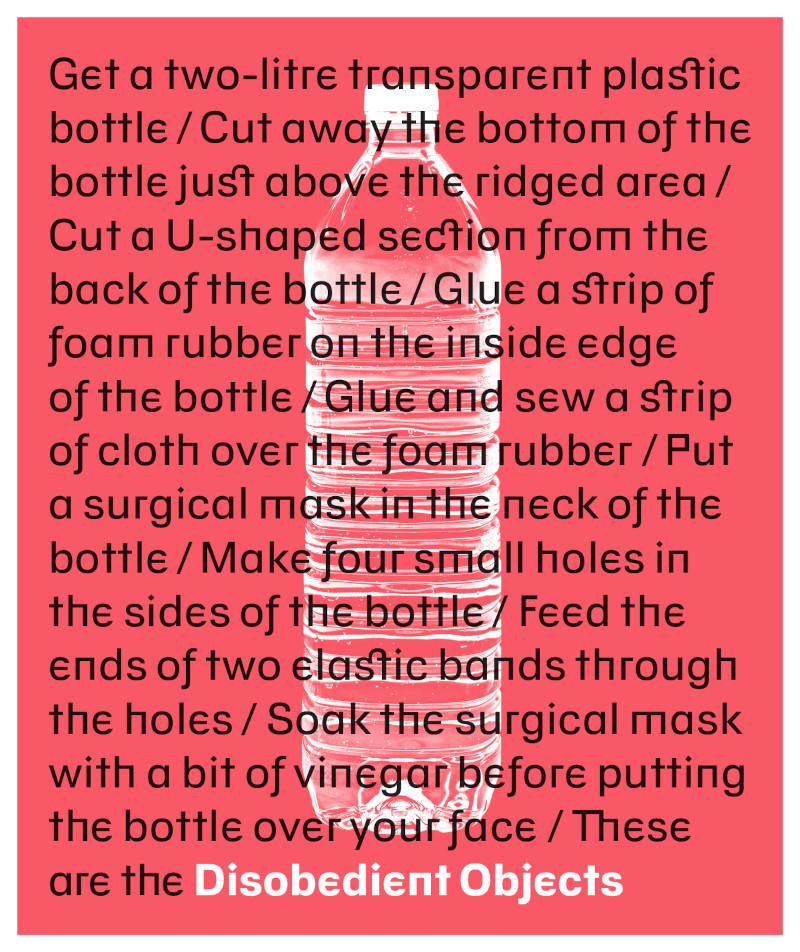
“This book explores the material culture of radical change and protest – from objects familiar to many, such as banners or posters, to the more militant, cunning or technologically cutting-edge, including lock-ons, book-blocs and activist robots. Focusing on social movements since 1980, the book features an introductory essay by the curators examining the history of objects in protest and activism, followed by six essays that look at particular objects, and the contexts in which they are used. It demonstrates how political activism drives a wealth of design ingenuity and collective creativity that defy standard definitions of art and design. Accompanies the V&A exhibition Disobedient Objects, July 2014 to February 2015.”
With essays by Mark Traugott, Anna Feigenbaum, Francesco Raparelli, David Graeber, Nicholas Thoburn, and Ana Longoni.
Publisher V&A Publishing, London, 2014
ISBN 9781851777976, 1851777970
144 pages
Exh. review: Richard Taws (West 86th, 2014).
Book review: Thomas Snow (Object, 2015).
Exhibition
Exhibition blog
WorldCat
PDF (63 MB)
Comment (0)