

Pavle Levi: Cinema by Other Means (2012–) [EN, SR]
Filed under book | Tags: · antifilm, art, art history, avant-garde, cinema, dada, experimental film, film, film history, film theory, lettrism, montage, structural film, surrealism, technology, yugoslavia

“Cinema by Other Means explores avant-garde endeavors to practice the cinema by using the materials and the techniques different from those commonly associated with the cinematographic apparatus. Using examples from both the historical and the post-war avant-garde — Dada, Surrealism, Lettrism, “structural-materialist” film, and more — Pavle Levi reveals a range of peculiar and imaginative ways in which filmmakers, artists, and writers have pondered and created, performed and transformed, the “movies” with or without directly grounding their work in the materials of film. The study considers artists and theorists from all over Europe — France, Italy, Soviet Union, Germany, Hungary — but it particularly foregrounds the context of the Yugoslav avant-garde. Cinema by Other Means offers the English-language reader a thorough explication of an assortment of distinctly Yugoslav artistic phenomena, such as the Zenithist cine-writings of the 1920s, the proto-structural Antifilm movement of the early 1960s, and the “ortho-dialectical” film-poetry of the 1970s.”
Publisher Oxford University Press, 2012
ISBN 019984142X, 9780199841424
224 pages
Reviews: Matilde Nardelli (Oxford Art Journal, 2013), Greg DeCuir (Jump Cut, 2013), Bojan Jovic (Biblid, 2013, SR).
Exh. review: De Cuir (ARTMargins, 2013).
Cinema by Other Means (English, 2012, updated on 2024-4-26)
Kino drugim sredstvima (Serbian, trans. Đorđe Tomić, 2013, added on 2024-4-26)
Craig Dworkin: No Medium (2013)
Filed under book | Tags: · architecture, art, art theory, attention, body, book, conceptual art, dada, film, fluxus, literature, media, music, painting, paper, phonograph, sculpture, sex, silence, temporality, time, translation, typography

“In No Medium, Craig Dworkin looks at works that are blank, erased, clear, or silent, writing critically and substantively about works for which there would seem to be not only nothing to see but nothing to say. Examined closely, these ostensibly contentless works of art, literature, and music point to a new understanding of media and the limits of the artistic object.
Dworkin considers works predicated on blank sheets of paper, from a fictional collection of poems in Jean Cocteau’s Orphée to the actual publication of a ream of typing paper as a book of poetry; he compares Robert Rauschenberg’s Erased De Kooning Drawing to the artist Nick Thurston’s erased copy of Maurice Blanchot’s The Space of Literature (in which only Thurston’s marginalia were visible); and he scrutinizes the sexual politics of photographic representation and the implications of obscured or obliterated subjects of photographs. Reexamining the famous case of John Cage’s 4’33”, Dworkin links Cage’s composition to Rauschenberg’s White Paintings, Ken Friedman’s Zen for Record (and Nam June Paik’s Zen for Film), and other works, offering also a “guide to further listening” that surveys more than 100 scores and recordings of “silent” music.
Dworkin argues that we should understand media not as blank, base things but as social events, and that there is no medium, understood in isolation, but only and always a plurality of media: interpretive activities taking place in socially inscribed space.”
Publisher MIT Press, 2013
ISBN 0262018705, 9780262018708
219 pages
Interview with the author (Critical Margins)
Author’s lecture at Penn Poetry & Poetics (video, 19 min)
Reviews: Johanna Drucker (Los Angeles Review of Books), Michael Leong (Hyperallergic).
Commentary: Richard Marshall (3:AM Magazine).
Mutually: Communities of the 1970s and 1980s / Navzájem: Společenství 70. a 80. let, catalogue (2013) [EN/SK/CZ]
Filed under catalogue | Tags: · 1970s, 1980s, archive, art, art history, counterculture, czechoslovakia, film, hungary, participation, photography, video
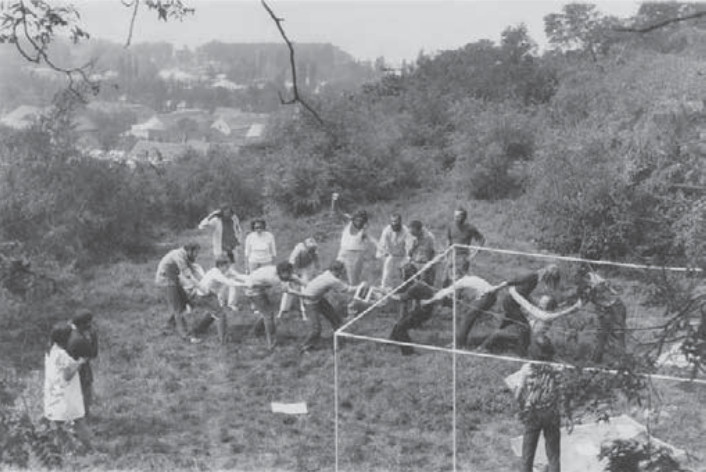
Catalogue for an exhibition held in March-May 2013 at tranzitdisplay in Prague and The Brno House of Arts, Czech Republic, curated by Barbora Klímová, Daniel Grúň and Filip Cenek.
The selected fragments in this exhibition, borrowed from the archives of Moravian, Slovak, and Hungarian artists, reference different communities within the framework of “unofficial culture” during the period of Czechoslovak normalisation in the 1970s-80s.
Publisher tranzitdisplay, Prague, and The House of Arts, Brno, 2013
44 pages
via Academia.edu