

Darren Wershler, Lori Emerson, Jussi Parikka: The Lab Book: Situated Practices in Media Studies (2022)
Filed under book | Tags: · apparatus, collaboration, computing, hackerspace, infrastructure, innovation, knowledge production, labour, management, media archeology, media labs, media studies, prototyping, race, research, space, technique, technology, university
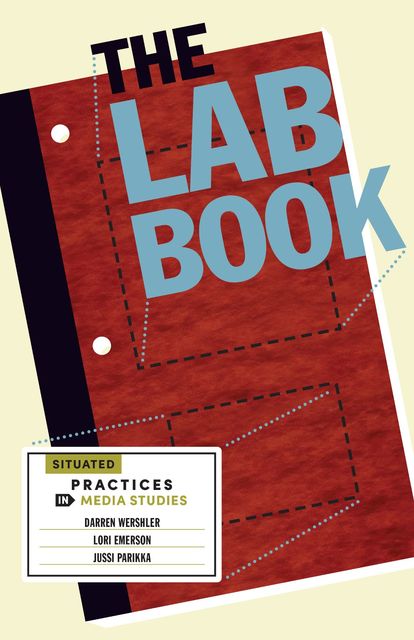
“From the “Big Science” of Bell Laboratories to the esoteric world of séance chambers to university media labs to neighborhood makerspaces, places we call “labs” are everywhere—but how exactly do we account for the wide variety of ways that they produce knowledge? More than imitations of science and engineering labs, many contemporary labs are hybrid forms that require a new methodological and theoretical toolkit to describe. The Lab Book investigates these vital, creative spaces, presenting readers with the concept of the “hybrid lab” and offering an extended—and rare—critical investigation of how labs have proliferated throughout culture.
Organized by interpretive categories such as space, infrastructure, and imaginaries, The Lab Book uses both historical and contemporary examples to show how laboratories have become fundamentally connected to changes in the contemporary university. Its wide reach includes institutions like the MIT Media Lab, the Tuskegee Institute’s Jesup Wagon, ACTLab, and the Media Archaeological Fundus. The authors cover topics such as the evolution and delineation of lab-based communities, how labs’ tools and technologies contribute to defining their space, and a glossary of key hybrid lab techniques.”
Publisher University of Minnesota Press, March 2022
ISBN 9781517902179, 1517902177
x+333 pages
Project website
Publisher
WorldCat
HTML (Manifold)
Comment (0)Christina Dunbar-Hester: Hacking Diversity: The Politics of Inclusion in Open Technology Cultures (2020)
Filed under book | Tags: · care, community, computing, diversity, diy, ethnicity, feminism, floss, gender, hacker culture, hackerspace, hacking, identity, open source, openness, participation, politics, queer, race, technology, women
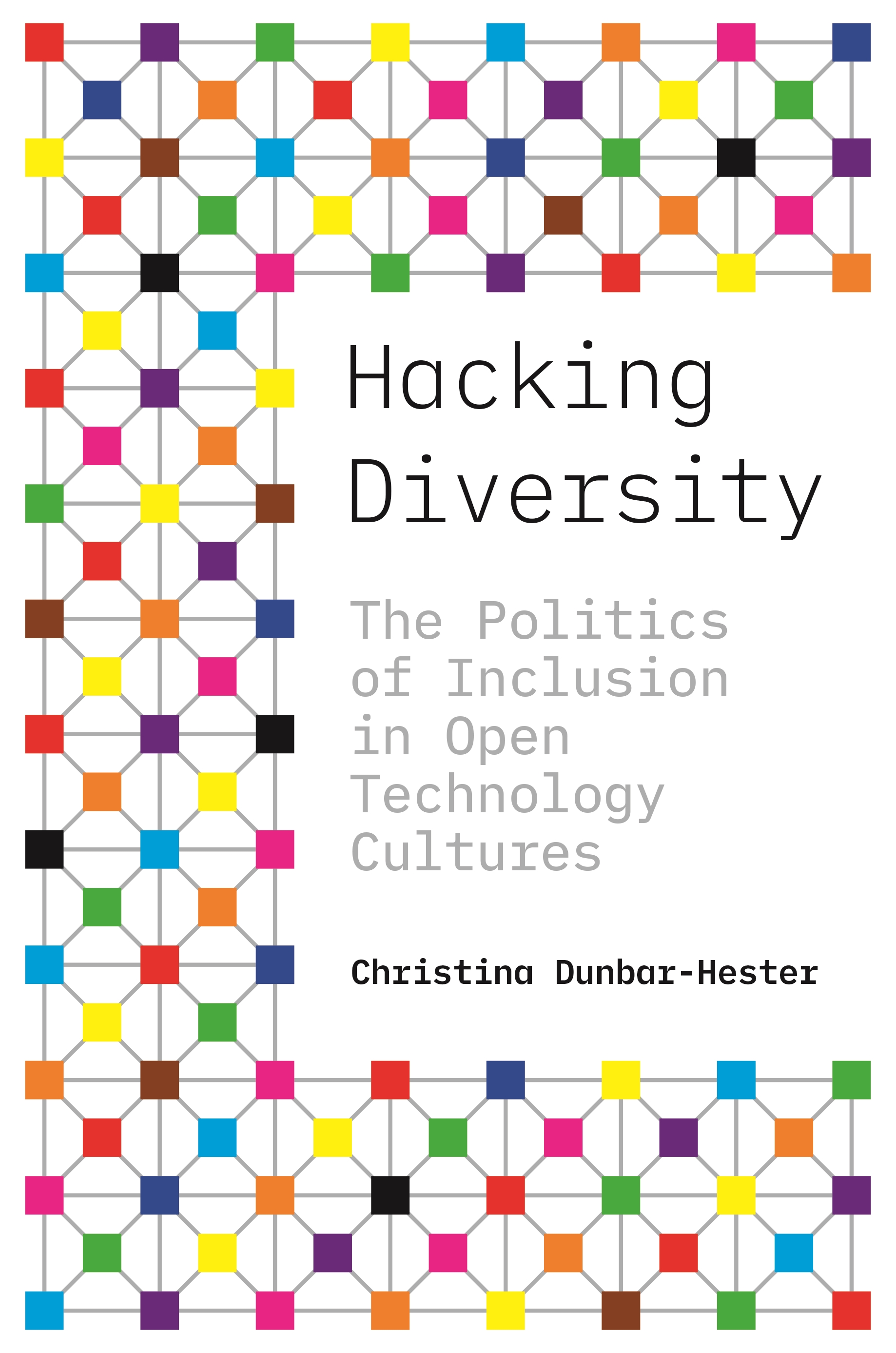
“A firsthand look at efforts to improve diversity in software and hackerspace communities.
Hacking, as a mode of technical and cultural production, is commonly celebrated for its extraordinary freedoms of creation and circulation. Yet surprisingly few women participate in it: rates of involvement by technologically skilled women are drastically lower in hacking communities than in industry and academia. Hacking Diversity investigates the activists engaged in free and open-source software to understand why, despite their efforts, they fail to achieve the diversity that their ideals support.
Christina Dunbar-Hester shows that within this well-meaning volunteer world, beyond the sway of human resource departments and equal opportunity legislation, members of underrepresented groups face unique challenges. She brings together more than five years of firsthand research: attending software conferences and training events, working on message boards and listservs, and frequenting North American hackerspaces. She explores who participates in voluntaristic technology cultures, to what ends, and with what consequences. Digging deep into the fundamental assumptions underpinning STEM-oriented societies, Dunbar-Hester demonstrates that while the preferred solutions of tech enthusiasts—their “hacks” of projects and cultures—can ameliorate some of the “bugs” within their own communities, these methods come up short for issues of unequal social and economic power. Distributing “diversity” in technical production is not equal to generating justice.
Hacking Diversity reframes questions of diversity advocacy to consider what interventions might appropriately broaden inclusion and participation in the hacking world and beyond.”
Publisher Princeton University Press, 2020
Princeton Studies in Culture and Technology series
ISBN 9780691182070, 0691182078
xi+271 pages
Reviews: Jenna P. Carpenter (Tech & Society, 2021), Rebecca Ortenberg (Lady Science, 2020), Samantha Shorey (International Journal of Communication, 2020).
EPUB (updated on 2022-8-29)
PDF (added on 2022-12-12)
Charlotte Johannesson. Take Me to Another World (2021) [EN, ES]
Filed under book, catalogue | Tags: · art, computer graphics, computing, counterculture, textile

“A key figure of Swedish counterculture and the creator of the first digital arts laboratory in Nordic countries, Charlotte Johannesson has worked primarily with two tools: the artisan technology of the loom and digital IT programming technology, exploring and throwing into relief the connections, both conceptual and methodological, that exist between the two.
Charlotte Johannesson. Take Me to Another World renders an account of the meticulous research process around colour and line that the artist executes in her textile and digital practice. It also spotlights the contribution of Danish writer and artist Amalie Smith, who set up a dialogue between Johannesson’s career and her own present-tense narrative. Furthermore, the publication incorporates an interview conducted with the artist in 2012, re-edited and translated for this occasion.”
Publisher Museo Reina Sofía, Madrid, 2021
Creative Commons BY-NC-ND 4.0 License
ISBN 9788480266246, 8480266244
172 pages
PDF, PDF (English)
PDF, PDF (Spanish)