Karl Toepfer: Empire of Ecstasy: Nudity and Movement in German Body Culture, 1910-1935 (1997)
Filed under book | Tags: · 1910s, 1920s, 1930s, avant-garde, ballet, bauhaus, body, dance, expressionism, germany, photography, theatre, weimar republic
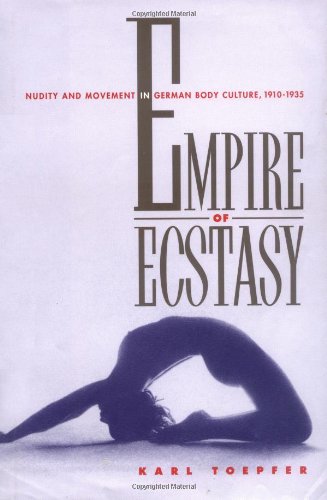
Empire of Ecstasy offers an interpretation of the explosion of German body culture between the two wars—nudism and nude dancing, gymnastics and dance training, dance photography and criticism, and diverse genres of performance from solo dancing to mass movement choirs. Karl Toepfer presents this dynamic subject as a vital and historically unique construction of “modern identity.”
The modern body, radiating freedom and power, appeared to Weimar artists and intelligentsia to be the source of a transgressive energy, as well as the sign and manifestation of powerful, mysterious “inner” conditions. Toepfer shows how this view of the modern body sought to extend the aesthetic experience beyond the boundaries imposed by rationalized life and to transcend these limits in search of ecstasy. With the help of much unpublished or long-forgotten archival material (including many little-known photographs), he investigates the process of constructing an “empire” of appropriative impulses toward ecstasy.
Toepfer presents the work of such well-known figures as Rudolf Laban, Mary Wigman, and Oskar Schlemmer, along with less-known but equally fascinating body culture practitioners. His book is certain to become required reading for historians of dance, body culture, and modernism.
Publisher University of California Press, 1997
ISBN 0520918274, 9780520918276
422 pages
PDF’d HTML, HTML (from the publisher)
See also Mel Gordon, Voluptuous Panic: The Erotic World of Weimar Berlin, 2000–.
Comment (0)Paul Klee Notebooks, vol. 1: The Thinking Eye (1956–) & vol. 2: The Nature of Nature (1970–)
Filed under book | Tags: · art, art education, art theory, bauhaus, design, image, pedagogy
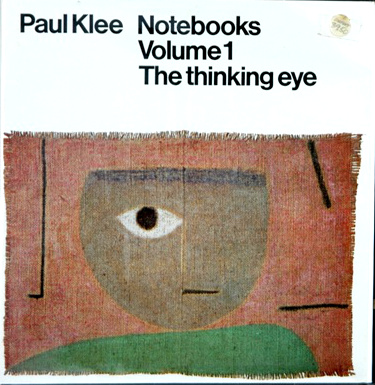
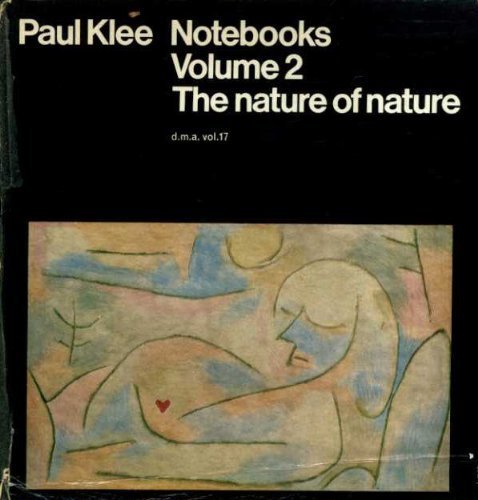
Paul Klee Notebooks is a two-volume work by Paul Klee that collects his lectures at the Bauhaus schools in 1920s Germany and his other main essays on modern art. These works are considered so important for understanding modern art that they are compared to the importance that Leonardo’s A Treatise on Painting had for Renaissance; Herbert Read called the collection “the most complete presentation of the principles of design ever made by a modern artist – it constitutes the Principia Aesthetica of a new era of art, in which Klee occupies a position comparable to Newton’s in the realm of physics.”
The final work was edited by Swiss artist Jürg Spiller. In an earlier 1925 shorter book, Pedagogical Sketchbook, Klee published a condensation of his lectures at the Weimar Bauhaus. (from Wikipedia)
Volume 1
First published as Das bildnerische Denken, Schwabe & Co., Basel, 1956
Translated by Ralph Manheim
Edited by Jürg Spiller
Publisher Lund Humphries, London, 1961
541 pages
Volume 2
First published as Unendliche Naturgeschichte, Schwabe & Co., Basel, 1970
Translated by Heinz Norden
Edited by Jürg Spiller
Publisher Lund Humphries, London, 1973
454 pages
Volume 1: The Thinking Eye (42 MB, updated on 2019-12-25)
Volume 2: The Nature of Nature (49 MB, updated on 2019-12-25)
See also Klee’s class notes in manuscript (1921-31) and his Pedagogical Sketchbook (1925–).
Comments (6)ReD (Revue Devětsilu): modern culture monthly (1927-1931) [Czech]
Filed under magazine | Tags: · architecture, art, art theory, avant-garde, bauhaus, constructivism, czechoslovakia, dada, design, film, graphic design, literature, photography, poetry, psychoanalysis, radio, surrealism, theatre
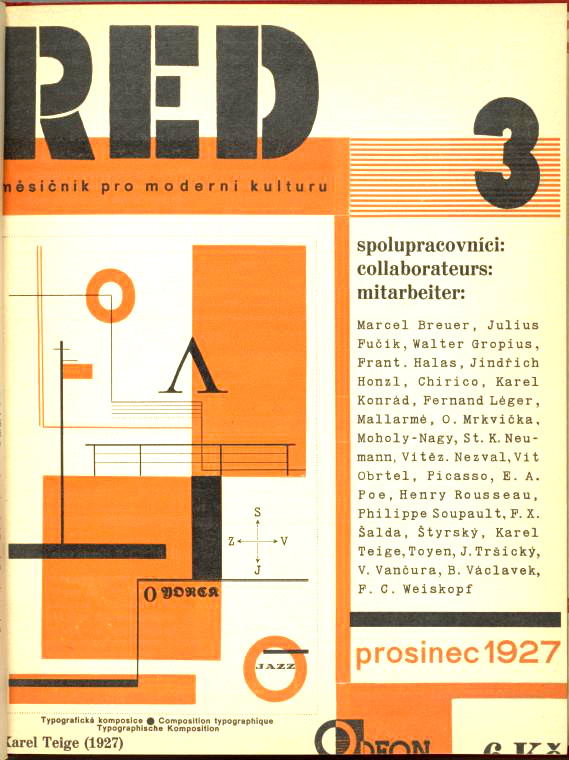
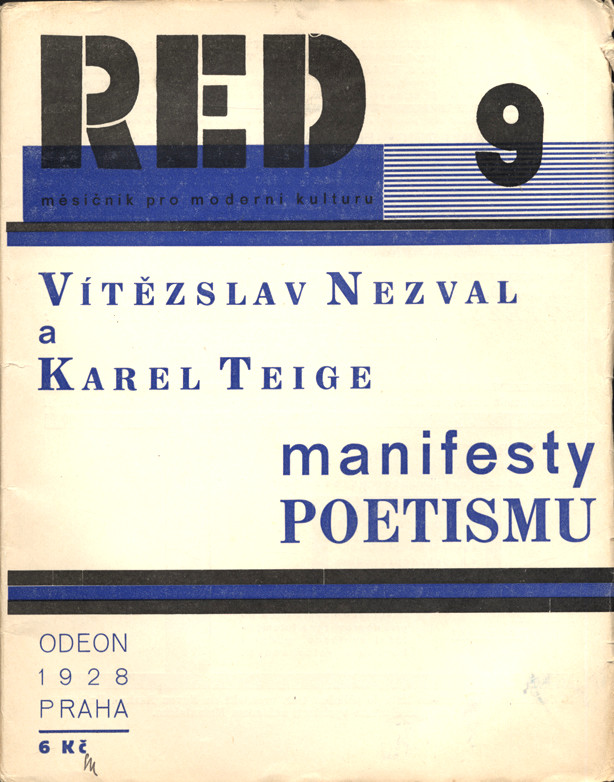
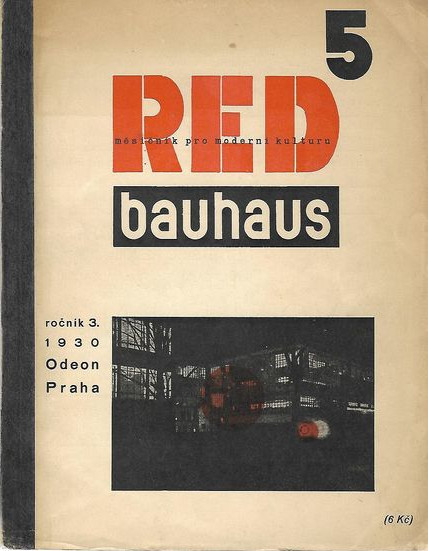
ReD (měsíčník pro moderní kulturu / Revue internationale illustrée de l’activité contemporaine / Internationale Monatsschrift für moderne Gestaltung) was an art magazine published by members of the Czech avant-garde art collective Devětsil.
Thirty numbers were published, with the special issues on the Russian avant-garde, Bauhaus, and photography/film/typography.
Several manifestos appeared in the journal: Toyen and Jindřich Štyrský’s Artificielisme (1:1, 1927), Karel Teige’s second Poetism manifesto [Manifest Poetismu] (1:9, 1928), and the Left Front [Levá fronta]’s founding manifesto (3:2, 1929).
Edited and designed by Karel Teige
Publisher Odeon – Jan Fromek, Prague
via NYPL Digital Library
Each volume in a single PDF (low resolution):
Volume I, 1927-1928 (10 issues, 360 pages)
Volume II, 1928-1929 (10 issues, 324 pages)
Volume III, 1929-1931 (10 issues, 315 pages)
Selected issues in separate PDFs:
The Russian Issue (1:2, Nov 1927)
Foto Film Typo Issue (2:8, Apr 1929)
The Bauhaus Issue (3:5, Feb 1930, partly in German)
JPG pages (search in page annotations):
View online
See also Devětsil: Revoluční sborník (1922), edited by Jaroslav Seifert and Karel Teige, in Czech.
Comment (1)