

Whitney Trettien: Cut/Copy/Paste: Fragments from the History of Bookwork (2021)
Filed under book | Tags: · book, copy, feminism, history, materiality, media, print, publishing, women
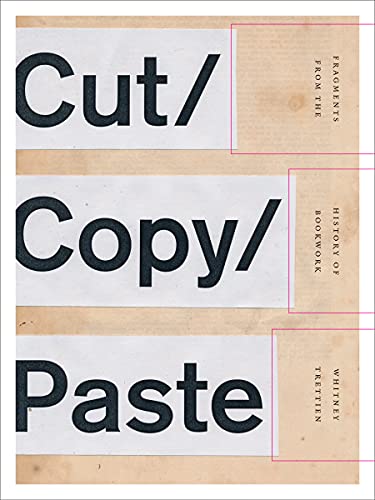
“In Cut/Copy/Paste, Whitney Trettien journeys to the fringes of the London print trade to uncover makerspaces and collaboratories where paper media were cut up and reassembled into radical, bespoke publications. Bringing these long-forgotten objects back to life through hand-curated digital resources, Trettien shows how early experimental book hacks speak to the contemporary conditions of digital scholarship and publishing. As a mixed-media artifact itself, Cut/Copy/Paste enacts for readers what Trettien argues: that digital forms have the potential to decenter patriarchal histories of print.
From the religious household of Little Gidding—whose biblical concordances and manuscripts exemplify protofeminist media innovation—to the queer poetic assemblages of Edward Benlowes and the fragment albums of former shoemaker John Bagford, Cut/Copy/Paste demonstrates history’s relevance to our understanding of current media. Tracing the lives and afterlives of amateur “bookwork,” Trettien creates a method for identifying and comprehending hybrid objects that resist familiar bibliographic and literary categories. In the process, she bears witness to the deep history of radical publishing with fragments and found materials.
With many of Cut/Copy/Paste’s digital resources left open for additions and revisions, this book reimagines our ideas of publication while fostering a spirit of generosity and inclusivity.”
Publisher University of Minnesota Press, Dec 2021
Creative Commons BY-NC-ND 4.0 International License
ISBN 9781517904098, 1517904099
328 pages
HTML (Manifold)
Comment (0)David Graeber, David Wengrow: The Dawn of Everything: A New History of Humanity (2021)
Filed under book | Tags: · agriculture, bureaucracy, city, critique, history, human, indigenous peoples, politics, production, progress, property, sovereignty
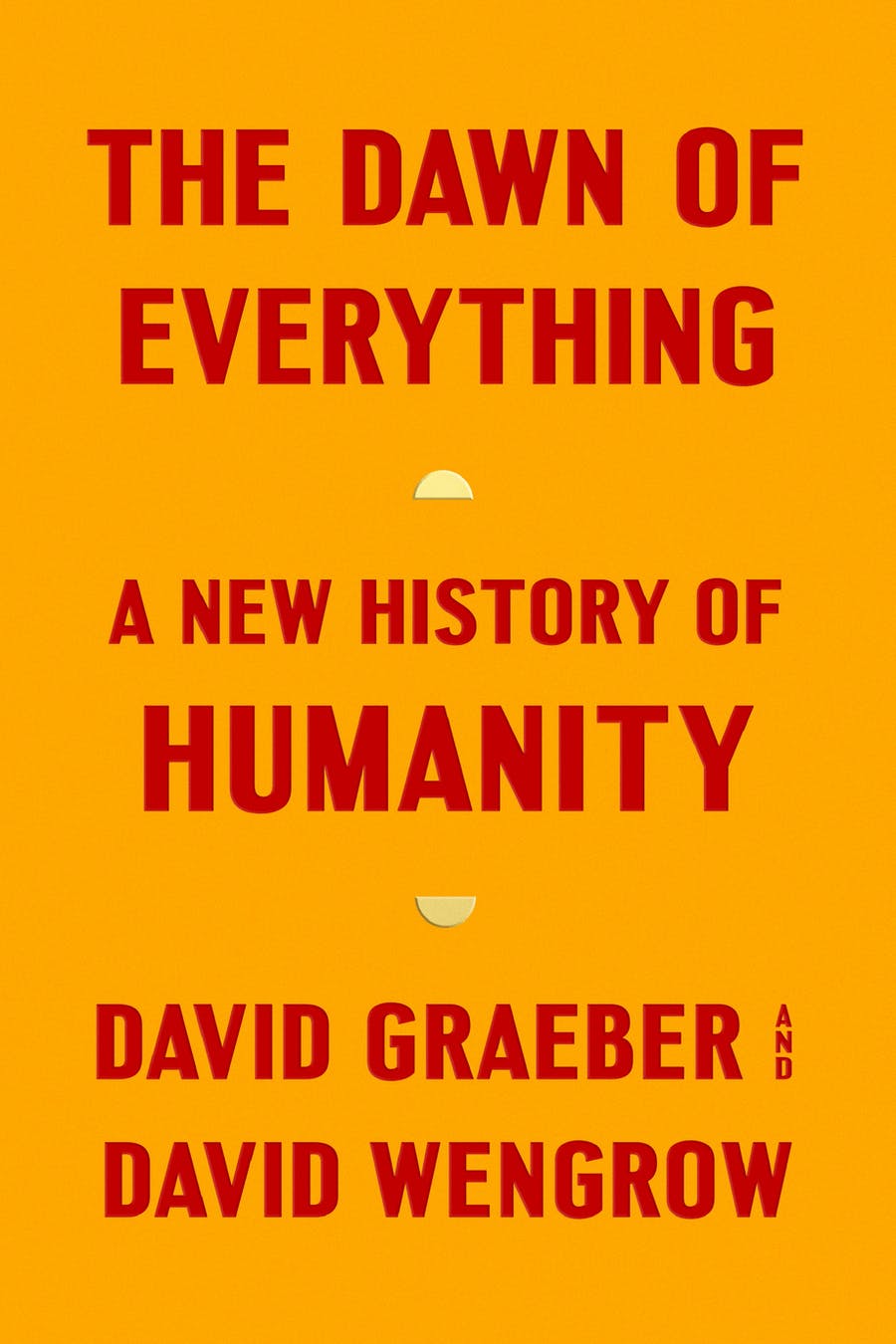
“For generations, our remote ancestors have been cast as primitive and childlike–either free and equal innocents, or thuggish and warlike. Civilization, we are told, could be achieved only by sacrificing those original freedoms or, alternatively, by taming our baser instincts. David Graeber and David Wengrow show how such theories first emerged in the eighteenth century as a conservative reaction to powerful critiques of European society posed by Indigenous observers and intellectuals. Revisiting this encounter has startling implications for how we make sense of human history today, including the origins of farming, property, cities, democracy, slavery, and civilization itself.
Drawing on research in archaeology and anthropology, the authors show how history becomes a far more interesting place once we learn to throw off our conceptual shackles and perceive what’s really there. If humans did not spend 95 percent of their evolutionary past in tiny bands of hunter-gatherers, what were they doing all that time? If agriculture, and cities, did not mean a plunge into hierarchy and domination, then what kinds of social and economic organization did they lead to? The answers are often unexpected, and suggest that the course of human history may be less set in stone, and more full of playful, hopeful possibilities, than we tend to assume.”
Publisher Farrar, Straus and Giroux, November 2021
ISBN 9780374157357, 0374157359
xii+692 pages
Reviews: William Deresiewicz (The Atlantic, 2021), Giulio Ongaro (Jacobin/Tribune, 2021), Jennifer Schuessler (The New York Times, 2021), Kwame Anthony Appiah (The New York Review, 2021), David Priestland (The Guardian, 2021), Emily Kern (Boston Review, 2021), Steve Rushton (Bella Caledonia, 2021), George Scialabba (New Republic, 2021), Chris Knight, Nancy Lindisfarne and Jonathan Neale (Monthly Review, 2021), Tunku Varadarajan (Wall Street Journal, 2021), Erle C. Ellis (Science, 2021), Peter Isackson (Fair Observer, 2021), Noah Berlatsky (NBC News, 2021), Annalee Newitz (Washington Post, 2021), Matthew Porges (LA Review of Books, 2022), Richard Handler (TLS, 2022), anon. (Astral Codex Ten, 2022), Milena Bartlová (A2larm, 2022, CZ), Joe Gill (Middle East Eye, 2023), Jan Bělíček, Eva Klíčová (Alarm, podcast, 2024, CZ), more.
Book website
Publisher
WorldCat
October, 174: A Questionnaire on Decolonization (2020)
Filed under survey | Tags: · activism, art, black people, collecting, colonialism, decoloniality, decolonization, eurocentrism, history, imperialism, indigenous peoples, land, museum, postcolonialism, race, slavery, violence
“The term decolonize has gained a new life in recent art activism, as a radical challenge to the Eurocentrism of museums (in light of Native, Indigenous, and other epistemological perspectives) as well as in the museum’s structural relation to violence (either in its ties to oligarchic trustees or to corporations engaged in the business of war or environmental depredation). In calling forth the mid-twentieth-century period of decolonization as its historical point of reference, the word’s emphatic return is rhetorically powerful, and it corresponds to a parallel interest among scholars in a plural field of postcolonial or global modernisms. The exhortation to decolonize, however, is not uncontroversial-some believe it still carries a Eurocentric bias. Indeed, it has been proposed that, for the West, de-imperialization is perhaps even more urgent than decolonization.
What does the term decolonize mean to you in your work in activism, criticism, art, and/or scholarship? Why has it come to play such an urgent role in the neoliberal West? How can we link it historically with the political history of decolonization, and how does it work to translate postcolonial theory into a critique of the neocolonial contemporary art world?”
Respondents include Nana Adusei-Poku, Brook Andrew, Sampada Aranke, Ian Bethell-Bennett, Kader Attia, Andrea Carlson, Elise Y. Chagas, ISUMA, Iftikhar Dadi, Janet Dees, Nitasha Dhillon, Hannah Feldman, Josh T. Franco, David Garneau, Renee Green, Iman Issa, Arnold J. Kemp, Thomas Lax, Nancy Luxon, Nelson Maldonado-Torres, Saloni Mathur, Tiona Nekkia McClodden, Alan Michelson, Partha Mitter, Isabela Muci Barradas, Steven Nelson, Ugochukwu-Smooth C. Nzewi, Alessandro Petti, Paulina Pineda, Christopher Pinney, Elizabeth Povinelli, Ryan Rice, Andrew Ross, Paul Chaat Smith, Nancy Spector, Francoise Verges, Rocio Zambrana, and Joseph R. Zordan.
Edited by Huey Copeland, Hal Foster, David Joselit, and Pamela M. Lee
Publisher MIT Press, Fall 2020
Open access
ISSN 0162-2870
123 pages